














 Mean Stack Development
 Vue JS Development
 Javascript Development
 React JS Development
 Angular JS Development
 Next JS development
 Java Development
 Python Development
 Django Development
 Cherrypy Development
 C# Development
 ASP.NET Development
 NodeJS Development
 Laravel Development
 CodeIgniter Development
 Zend Development
 Ruby on Rails Development
 CakePHP Development
 PHP Website Development
 Symfony Development
 Drupal Development
 Joomla Development
 Wordpress Development
 .NET Nuke Development
 Kentico
 Umbraco
 .NET MAUI Development
 Xamarin Application Development
 iOS Application Development
 Android Application Development
 Android Wear App Development
 Ionic Development
 iBeacon Application Development
 Universal Windows Platform (UWP)
 Kotlin Application Development
 Swift Application Development
 Flutter Application Development
 PWA Application Development
 Flutter Health Tech & Wearable App Development Company
 React Native Health Tech Wearable App Development
 Offshore Software Development
 Custom Application Development
 Front-End Development
 Full Stack Development
 AI & Machine Learning
 Custom CRM Solutions
 Flask Software Development
 Electron JS Development
 ChatGPT Development
 Telemedicine App Development
 Build Smart Telemedicine Platform
 Beauty & Salon App Solutions
 Hire Workato Experts
 Magento Development
 Magento 2.0 Development
 Magento Enterprise
 Shopping Cart Development
 Prestashop Development
 Shopify Development
 Open Cart Development
 WooCommerce Development
 BigCommerce Development
 NopCommerce Development
 Virto Commerce Development
 AspDotNetStorefront Development
 .NET Application Development
 Microsoft Dynamics CRM
 VB .NET Development
 Sharepoint Migration
 ASP.NET Core Development
 ASP.NET MVC Development
 AJAX Development
 Agile Development
 Microsoft Bot
 Microsoft Blazor
 Microsoft Azure Cognitive
 HTML 5
 UI/UX Design
 Graphic Design
 Adobe Photoshop
 XML Application Development
 Cloud Computing Solutions
 Azure Cloud App Development
 AWS Development
 Google Cloud Development
 Certified AWS IoT Services Developers
 DevOps Consulting & Development
 Kubernetes Consulting & Services
 SQL Programming Development
 MySQL Development
 MongoDB Development
 Big Data
 Robotic Process Automation
 Social Media Marketing
 Search Engine Optimization
 QA Testing
 Software Testing
 Software Security
 Maintenance And Support
 I.T. Consulting Services
 Business Intelligence
 YII Development
 Data Analysis
 Alexa Skills Development
 On Demand App for Mobile repairing services
 On Demand App for Car Service Booking
 On Demand App for Cleaning Services
 On Demand App for Pharmacy
 On Demand Dedicated Developers
 On Demand Lawyer App Development






 Nuki Smart Lock
 Salto Smart Lock
 TTlock Smart Lock
 NFC App Development
 Custom IOT Enabled Smart Lock
 Smart Locker Solutions
 Hospital Smart Lock Systems
 Hotel Smart Lock Systems
 Smart Home & Office Locks
 Smart Access for Schools & Colleges
 Unloc Smart Lock Integration
 Yale & August Smart Lock Integration
 Populife Smart Lock Integration
 Smart Lock Hardware Development
 Dairy IoT Solutions
 Agri IoT & AI Solutions
 Weather & Climate Solutions
 Water & Waste Management Solutions
 RaspBerry Pi
 Firmware Software Development
 ESP 32 Software Development
 Embedded Development
 Internet of Things
 Smart IoT Development
 IoT Sensor Integration & Development Solutions
 Smart IoT System Development for HVAC
 Tuya IoT App Development
 Particle IoT SDK
 IoT Development with AI
 Smart Pet GPS Tracker
 Dairy GPS Tracking Solutions
 GPS Fleet Management Software
 Car Rental & Subscription Solutions
 Car Buy & Sell Marketplace Development
 AI-Powered Car Wash App Development
 PCB Design & Fabrication
 IoT AC Automation
 AI–IoT Painting Solutions
 IoT Wearable Hardware & App Development
 HVAC Automation & AI Control Systems
 Smart Home IoT Engineering
 AI Embedded Systems
 AI Hardware Design Service
 Advanced IoT Hardware & Firmware Development
 Device Driver Development Services
 NXP i.MX RT Firmware & Hardware Services
 Microchip PIC & AVR Development
 Hire IoT Architects
 IoT Cloud & Infrastructure Solutions
 Infineon XMC / AURIX Development Services
 Matter & Thread IoT Services
 Native IoT Mobile App Development (BLE & Wi-Fi)
 Snapdragon IoT Firmware Development
 Renesas RA/RX Firmware Services
 Silicon Labs EFR32 Development Services
 Smart Wearable App Development
 Smart IoT Meters
 Smart Healthcare Wearable App Development
 Health Care Monitoring System
 Fitness Tracking App Development
 Smart Home Automation Apps
 nRF PCB Design
 ESP32 PCB Design
 Embedded Wearables Engineers
 Rental Property Management System
 Building Management System
 Smart Lighting Development
 Infineon Semiconductor Firmware Development Services
 Custom Camera Development: Hardware, Firmware & PCB Prototyping
 Smart Security Camera SDK
 Nordic Semiconductor SDK
 Infineon SDK
 Arduino SDK
 NFC Lock Integration
 Kerong Lock Integration
 IoT & AI Solutions for Manufacturing
 Smart Inventory & Logistics Solution
 Food & Beverage Industry Solutions
 Smart Hospitality Solutions
 Smart Property Management
 Custom Smart Home IOT SDK
 Smart IoT & AI in Healthcare
 AI-Powered Security Solutions
 Smart Home Safety & AI
 Veterinary Clinic Management (AI)
 Pet Care System (AI & IoT)
 Pet Training & Adoption (AI)
 Healthcare IoT Development
 Event Management Software
 Money Remittance App
 Money Lending App Development
 Utility and Bill Payment App
 IoT Mobile App Development (Flutter & React Native)
 AI & IoT Retail Solutions
 Smart EV App Development
 Smart Solar IoT & AI Solutions
 IoT-Based Energy Systems
 Smart Energy & Utilities Solutions
 6G Solutions
 IoT Security Solutions
 AI-Powered Lottery App Development
 AI-Sports Fitness Club Management
 Travel
 Real Estate
 Medical & Healthcare
 e-Learning
 Consumer Products
 Finance
 Automobile
 Media & Entertainment
 Billing Software
 Enterprise Resource Planning (ERP)
 Augumented & Virtual Reality
 Point of Sale(POS) Development
 Learning Management System
 EV Charging Solutions
 About Us
 Partners & Certifications
 Quality Assurance
 Our Clients & Testimonials
 Development Process
 Our Products
 Social Responsibility
 Work Ethics
 Vision & Mission
 Awards
 Live Project Demos
 Contact Us
 Case Studies
 Portfolio
 Blog
Blog
ESP32-C6 Matter, Thread & Zigbee Development
At Adequate Infosoft, we provide ESP32-C6 development services for startups, product manufacturers, automation companies, and enterprises.
Connected devices are not limited to operating in one technology ecosystem only. For instance, a smart switch could utilize Matter, a building sensor might utilize Thread, and an existing automation platform can still depend on Zigbee.
The ESP32-C6 helps develop devices that meet all the newer and older technologies' needs.
Our engineers handle the complete development process, including product architecture, PCB design, embedded firmware, wireless integration, mobile applications, cloud platforms, testing, certification preparation, and production support.
We are not just connecting a development board to a network. Our goals include developing dependable, safe, and commercially successful products that are able to consistently operate in real-world conditions.
Why Choose the ESP32-C6 for Connected Products?
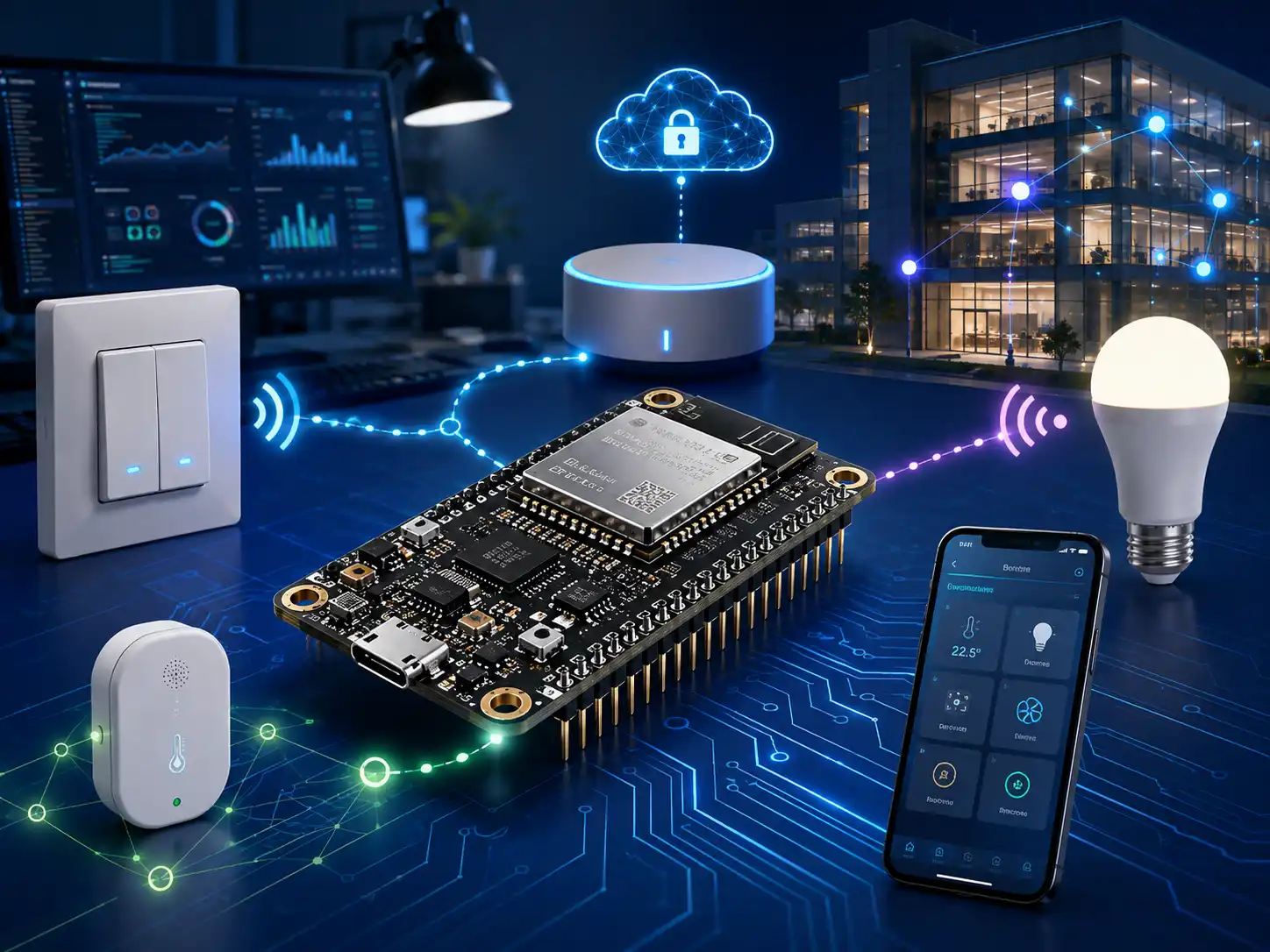
The ESP32-C6 is a low-consumption wireless system-on-chip with a 32-bit RISC-V processor at its core. This system encompasses a 2.4 GHz Wi-Fi 6, Bluetooth Low Energy, and an IEEE 802.15.4 radio feature in one solution platform. Its 802.15.4 capability is fully compatible with Thread 1.3 and Zigbee 3.0.
This combination gives product teams considerable flexibility. Wi-Fi can provide a direct connection to a local network or cloud platform.
Bluetooth LE can simplify device commissioning and nearby control. Thread can create a low-power IP-based mesh, while Zigbee can support established home and building automation installations.
The ESP32-C6 has also various requisite hardware interfaces such as GPIO, SPI, UART, I2C, I2S, PWM, ADC, USB Serial/JTAG, and TWAI. Therefore, It can connect with many devices such as relays, environmental sensors, display, measuring instruments, motors, security hardware, etc.
Our ESP32-C6 Development Services
Matter Device Development
Matter makes it possible for compatible devices to work across major smart-home ecosystems using a common, IP-based application standard. However, successful Matter development involves much more than adding a connectivity library.
We develop Matter-compatible switches, plugs, lights, sensors, controllers, locks, thermostats, bridges, and other connected products.
Our job can involve selecting devices types, implementing endpoints and clusters, managing attributes, commands, events, commissioning flows, onboarding using QR codes, managing access control systems, and storing data persistently.
We also perform device testing across ecosystems that are relevant to the project, such as Apple Home, Google Home, Amazon Alexa, or Home Assistant, depending on the product.
Matter over Thread Development
Thread is designed for secure, low-power mesh networking. Unlike conventional non-IP mesh protocols, Thread uses IPv6, allowing Matter messages to travel across an IP-based network without a proprietary application gateway.
The ESP32-C6 can be used for Matter-over-Thread end devices such as contact sensors, occupancy sensors, buttons, thermostats, lighting products, and battery-powered controls.
We configure the required OpenThread roles, commissioning behaviour, network credentials, sleepy-device operation, and communication with a Thread Border Router.
In regard to products powered by batteries, we take into account wake periods, sensor measurements, radio transmission, message resendings, and terminals outages and do not simply rely on a primitive deep sleep example. All of the above can decide whether the product will function for several weeks or for several years using a single battery.
Zigbee 3.0 Product Development
Zigbee technology is still utilized in areas such as smart lighting, energy management, security, hospitality, and building automation. Manufacturers must either enhance the Zigbee reach needed for their products or develop new devices that can support a Matter-related strategy in the future.
Our team develops Zigbee coordinators, routers, and end devices using the ESP32-C6. We implement appropriate device profiles, endpoints, clusters, reporting intervals, binding, groups, scenes, network joining, rejoining, and factory-reset behaviour.
We can develop standard Zigbee functionality or manufacturer-specific features when the intended coordinator supports them. Testing includes network loss, coordinator replacement, parent changes, dense device deployments, and operation in environments where Wi-Fi and other 2.4 GHz equipment are active.
Matter-to-Zigbee Bridge Development
A Matter bridge can make existing Zigbee products visible to Matter controllers without requiring every deployed device to be replaced. This is valuable for lighting systems, apartment installations, hotels, and commercial buildings with a substantial installed base of Zigbee equipment.
We design bridge firmware capable of identifying the Zigbee compatible devices, linking their functions to the proper Matter endpoints, coordinating device state and managing messages in both directions. Given the differences in the data models, it is critical to pay proper attention during the mapping process.
While a generic on-off device is easy to handle, the operating systems must be handled with care if dealing with scenes, proprietary parameters, battery information and other non-standard readings.
ESP32-C6 Hardware and PCB Engineering
Protocol support is only useful when the physical product has dependable radio performance. Our hardware engineering services cover component selection, schematics, power architecture, PCB layout, antenna placement, module selection, connector design, sensor interfaces, relay drivers, and manufacturing documentation.
Depending on enclosure size, range requirements, and installation conditions, we can use an ESP32-C6 module with an integrated PCB antenna or an external antenna connector. We consider antenna clearance, ground layout, noisy switching components, enclosure materials, and nearby metal parts early in the design.
Firmware Architecture and Security
Connected-device firmware must remain stable through network interruptions, invalid messages, interrupted updates, and years of field use. We structure firmware into maintainable components for connectivity, device drivers, application logic, storage, diagnostics, and update management.
Security can include secure boot, flash encryption, signed firmware, protected device credentials, authenticated communication, certificate handling, secure provisioning, anti-rollback controls, and controlled factory reset procedures. For Matter products, we also plan the secure injection and management of device-specific manufacturing information.
Project We Delivered: Multiprotocol Smart Room Controller
Project Background
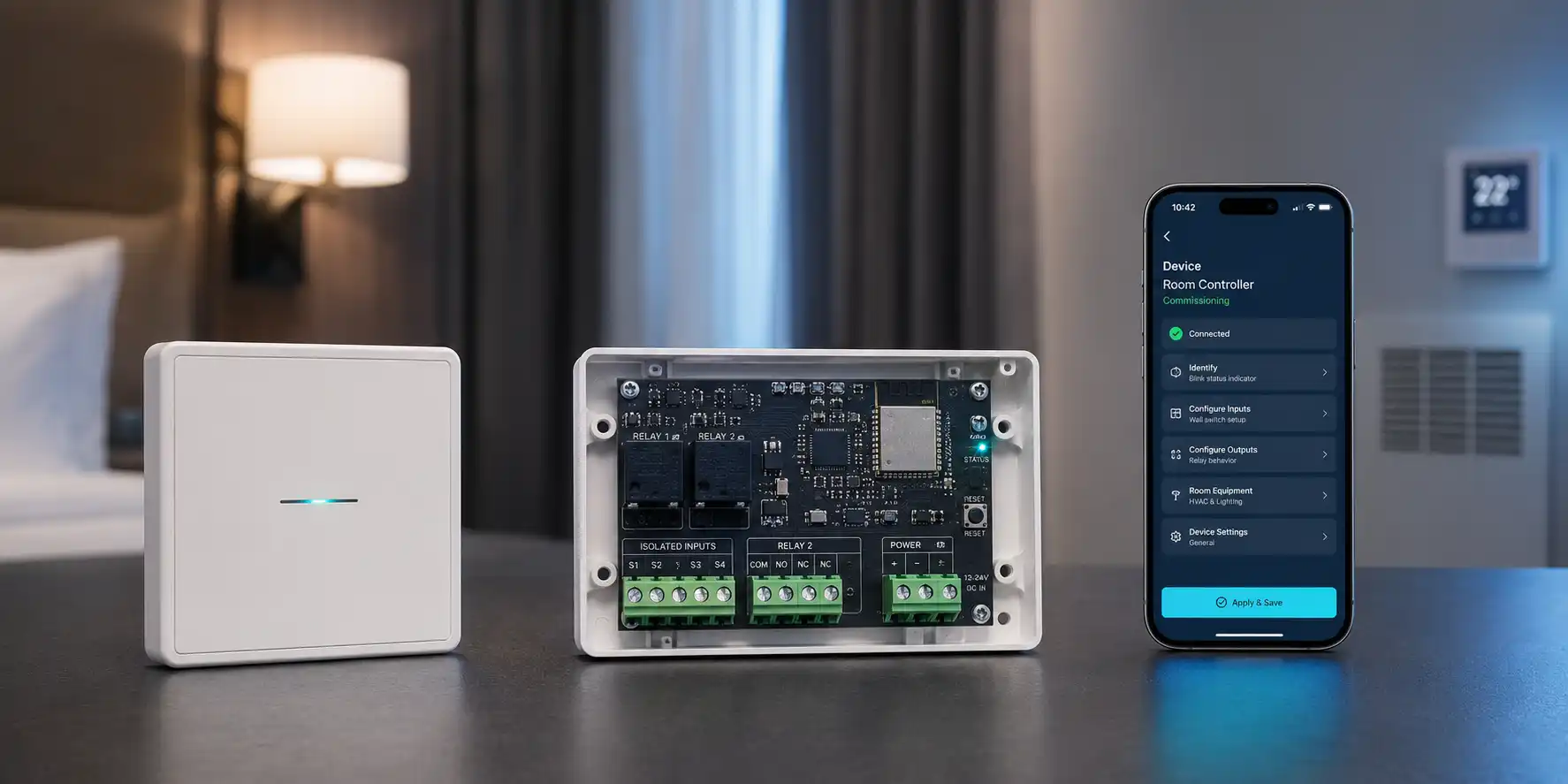
A building-automation company approached us to develop a compact room controller for apartments, serviced offices, and small hotels. The client already supplied Zigbee sensors and switches, but its newer customers wanted Matter compatibility and better integration with consumer smart-home platforms.
Creating different circuit boards solely for the Zigbee and Matter systems would have added various costs related to inventory, testing, and certifications. Thus, we chose to create a new ESP32-C6 hardware platform on which multiple firmware configurations can allow installing Zigbee as well as Matter-over-Thread systems.
Engineering the Hardware Platform
The controller needed to operate two relay outputs, read a temperature and humidity sensor, accept inputs from wall switches, and display equipment status through a small RGB indicator. It also had to fit inside an enclosure positioned close to mains wiring, which made power design and radio placement important.
We created the schematic and PCB around an ESP32-C6 module and added isolated input circuitry, relay drivers, a regulated power stage, service pads, and a physical reset and commissioning button. The antenna area was kept away from the relays and high-voltage section. We also added diagnostic points so production technicians could test power rails, inputs, outputs, and wireless operation without opening the finished unit repeatedly.
Matter, Thread and Zigbee Firmware
For new installations, we developed a Matter-over-Thread firmware profile. The controller could be commissioned through a standard Matter setup flow and represented its relays, environmental readings, and occupancy state through appropriate endpoints and clusters.
We implemented network recovery, settings storage, factory reset, and over-the-air (OTA) firmware update handling. Special attention was paid to retaining the correct relay state after a restart and preventing unintended switching during commissioning.
For the client's existing projects, we created a Zigbee 3.0 firmware profile using the same hardware. It supported joining and rejoining, attribute reporting, groups, configurable reporting intervals, and commands from the client's coordinator.
We also built a Matter bridge proof of concept. In this configuration, the ESP32-C6 communicated with selected Zigbee room devices and exposed their supported functionality to a Matter controller over Wi-Fi. This allowed the client to evaluate a gradual migration strategy rather than replacing its installed Zigbee devices immediately.
Testing and Result
We tested commissioning, repeated power cycling, network loss, controller restart, relay operation under load, sensor reporting, firmware updates, and factory-reset behaviour.
Coexistence testing was performed in a busy 2.4 GHz environment to identify channel and enclosure-related issues before the pilot build.
The end goal of the project provided the customer with a generic hardware layout that could be reused for many different product iterations. It enabled cutting down unnecessary engineering processes, maintaining compatibility with existing hardware using Zigbee standards, and creating a feasible path to Matter and Thread products.
Testing and Certification Preparation
Wireless interoperability cannot be confirmed by checking only whether a device connects once. We prepare test plans covering commissioning, command response, attribute reporting, network recovery, multi-admin use where applicable, software updates, reset behaviour, and long-duration operation.
Our engineers can help prepare products for relevant Matter, Thread, Zigbee, Bluetooth, radio, safety, and regional compliance processes. Support may include firmware configuration, documentation, test builds, issue investigation, and changes required after pre-certification or laboratory testing.
Mobile App, Gateway and Cloud Development
Some ESP32-C6 products require more than their capability for local ecosystem control. We design companion mobile applications for Android and iOS, administrative web sites, cloud APIs, device registries, alerts, user management, telemetry dashboards, and remote support tools.
Where cloud connectivity is required, we design it carefully so core local functions do not become dependent on an internet connection. Matter and Thread products should retain reliable local behaviour even when an external service is temporarily unavailable.
Applications We Develop
Our ESP32-C6 development experience can be applied to:
From Prototype to Production
A proof of concept answers whether an idea can work. Product engineering must also answer whether it can be manufactured, installed, updated, supported, and operated securely.
We help in creation of development kits, custom prototypes, updates of circuit boards, fixing firmware problems, making fixtures for tests, production of firmware, providing identity to devices, optimizing the bill of materials, small scale production, and figuring out the problems during production scaling. This ensures that the first prototype and last production unit are linked.
Work With an ESP32-C6 Development Team
No matter if you're developing a Matter-Thread product from scratch, updating a Zigbee compatible device family, or designing a bridge to connect old devices, we can provide assistance at all stages of the engineering process.
At our company, we can offer all necessary engineering and production experience for building firmware, electronics, wireless communication and devices of all types. Contact us to get a detailed development plan for your ESP32-C6 Matter, Thread or Zigbee project specifying its technical characteristics and commercial features.