














 Mean Stack Development
 Vue JS Development
 Javascript Development
 React JS Development
 Angular JS Development
 Next JS development
 Java Development
 Python Development
 Django Development
 Cherrypy Development
 C# Development
 ASP.NET Development
 NodeJS Development
 Laravel Development
 CodeIgniter Development
 Zend Development
 Ruby on Rails Development
 CakePHP Development
 PHP Website Development
 Symfony Development
 Drupal Development
 Joomla Development
 Wordpress Development
 .NET Nuke Development
 Kentico
 Umbraco
 .NET MAUI Development
 Xamarin Application Development
 iOS Application Development
 Android Application Development
 Android Wear App Development
 Ionic Development
 iBeacon Application Development
 Universal Windows Platform (UWP)
 Kotlin Application Development
 Swift Application Development
 Flutter Application Development
 PWA Application Development
 Flutter Health Tech & Wearable App Development Company
 React Native Health Tech Wearable App Development
 Offshore Software Development
 Custom Application Development
 Front-End Development
 Full Stack Development
 AI & Machine Learning
 Custom CRM Solutions
 Flask Software Development
 Electron JS Development
 ChatGPT Development
 Telemedicine App Development
 Build Smart Telemedicine Platform
 Beauty & Salon App Solutions
 Hire Workato Experts
 Magento Development
 Magento 2.0 Development
 Magento Enterprise
 Shopping Cart Development
 Prestashop Development
 Shopify Development
 Open Cart Development
 WooCommerce Development
 BigCommerce Development
 NopCommerce Development
 Virto Commerce Development
 AspDotNetStorefront Development
 .NET Application Development
 Microsoft Dynamics CRM
 VB .NET Development
 Sharepoint Migration
 ASP.NET Core Development
 ASP.NET MVC Development
 AJAX Development
 Agile Development
 Microsoft Bot
 Microsoft Blazor
 Microsoft Azure Cognitive
 HTML 5
 UI/UX Design
 Graphic Design
 Adobe Photoshop
 XML Application Development
 Cloud Computing Solutions
 Azure Cloud App Development
 AWS Development
 Google Cloud Development
 Certified AWS IoT Services Developers
 DevOps Consulting & Development
 Kubernetes Consulting & Services
 SQL Programming Development
 MySQL Development
 MongoDB Development
 Big Data
 Robotic Process Automation
 Social Media Marketing
 Search Engine Optimization
 QA Testing
 Software Testing
 Software Security
 Maintenance And Support
 I.T. Consulting Services
 Business Intelligence
 YII Development
 Data Analysis
 Alexa Skills Development
 On Demand App for Mobile repairing services
 On Demand App for Car Service Booking
 On Demand App for Cleaning Services
 On Demand App for Pharmacy
 On Demand Dedicated Developers
 On Demand Lawyer App Development









 Nuki Smart Lock
 Salto Smart Lock
 TTlock Smart Lock
 NFC App Development
 Custom IOT Enabled Smart Lock
 Smart Locker Solutions
 Hospital Smart Lock Systems
 Hotel Smart Lock Systems
 Smart Home & Office Locks
 Smart Access for Schools & Colleges
 Unloc Smart Lock Integration
 Yale & August Smart Lock Integration
 Populife Smart Lock Integration
 Smart Lock Hardware Development
 Dairy IoT Solutions
 Agri IoT & AI Solutions
 Weather & Climate Solutions
 Water & Waste Management Solutions
 RaspBerry Pi
 Firmware Software Development
 ESP 32 Software Development
 Embedded Development
 Internet of Things
 Smart IoT Development
 IoT Sensor Integration & Development Solutions
 Smart IoT System Development for HVAC
 Tuya IoT App Development
 Particle IoT SDK
 IoT Development with AI
 Smart Pet GPS Tracker
 Dairy GPS Tracking Solutions
 GPS Fleet Management Software
 Car Rental & Subscription Solutions
 Car Buy & Sell Marketplace Development
 AI-Powered Car Wash App Development
 PCB Design & Fabrication
 IoT AC Automation
 AI–IoT Painting Solutions
 IoT Wearable Hardware & App Development
 HVAC Automation & AI Control Systems
 Smart Home IoT Engineering
 AI Embedded Systems
 AI Hardware Design Service
 Advanced IoT Hardware & Firmware Development
 Device Driver Development Services
 NXP i.MX RT Firmware & Hardware Services
 Microchip PIC & AVR Development
 Hire IoT Architects
 IoT Cloud & Infrastructure Solutions
 Infineon XMC / AURIX Development Services
 Matter & Thread IoT Services
 Native IoT Mobile App Development (BLE & Wi-Fi)
 Snapdragon IoT Firmware Development
 Renesas RA/RX Firmware Services
 Silicon Labs EFR32 Development Services
 Smart Wearable App Development
 Smart IoT Meters
 Smart Healthcare Wearable App Development
 Health Care Monitoring System
 Fitness Tracking App Development
 Smart Home Automation Apps
 nRF PCB Design
 ESP32 PCB Design
 Embedded Wearables Engineers
 Rental Property Management System
 Building Management System
 Smart Lighting Development
 Infineon Semiconductor Firmware Development Services
 Custom Camera Development: Hardware, Firmware & PCB Prototyping
 Smart Security Camera SDK
 Nordic Semiconductor SDK
 Infineon SDK
 Arduino SDK
 NFC Lock Integration
 Kerong Lock Integration
 IoT & AI Solutions for Manufacturing
 Smart Inventory & Logistics Solution
 Food & Beverage Industry Solutions
 Smart Hospitality Solutions
 Smart Property Management
 Custom Smart Home IOT SDK
 Smart IoT & AI in Healthcare
 AI-Powered Security Solutions
 Smart Home Safety & AI
 Veterinary Clinic Management (AI)
 Pet Care System (AI & IoT)
 Pet Training & Adoption (AI)
 Healthcare IoT Development
 Event Management Software
 Money Remittance App
 Money Lending App Development
 Utility and Bill Payment App
 IoT Mobile App Development (Flutter & React Native)
 AI & IoT Retail Solutions
 Smart EV App Development
 Smart Solar IoT & AI Solutions
 IoT-Based Energy Systems
 Smart Energy & Utilities Solutions
 6G Solutions
 IoT Security Solutions
 AI-Powered Lottery App Development
 AI-Sports Fitness Club Management
 Travel
 Real Estate
 Medical & Healthcare
 e-Learning
 Consumer Products
 Finance
 Automobile
 Media & Entertainment
 Billing Software
 Enterprise Resource Planning (ERP)
 Augumented & Virtual Reality
 Point of Sale(POS) Development
 Learning Management System
 EV Charging Solutions
 About Us
 Partners & Certifications
 Quality Assurance
 Our Clients & Testimonials
 Development Process
 Our Products
 Social Responsibility
 Work Ethics
 Vision & Mission
 Awards
 Live Project Demos
 Contact Us
 Case Studies
 Portfolio
 Blog
Blog
EFR32BG26 Wearable and Medical Device Development Company
At Adequate Infosoft, we build connected wearable and medical devices using the Silicon Labs EFR32BG26 wireless SoC.
Our engineering team assists the entire life cycle of the product, from the initial phase of technical planning, selecting the necessary sensors, designing electronics, embedded firmware, ensuring compatibility with Bluetooth Low Energy devices, developing mobile devices and platforms, and materials involved in prototypes and testing.
Wearable products are considered difficult from the engineering point of view. The device has to be small and comfortable yet provide reliable readings from the sensors, transmit data wirelessly securely, and have the desired battery life.
Medical and wellness products introduce further considerations, such as data integrity, traceability, privacy, risk management, and reliable operation under real-world conditions.
We use the EFR32BG26 for products that need capable local processing and robust Bluetooth connectivity within a power-conscious design.
Depending on the application, our team can develop wearable health monitors, portable diagnostic devices, rehabilitation products, connected medication devices, patient-safety systems, fitness trackers, and clinical data-collection tools.
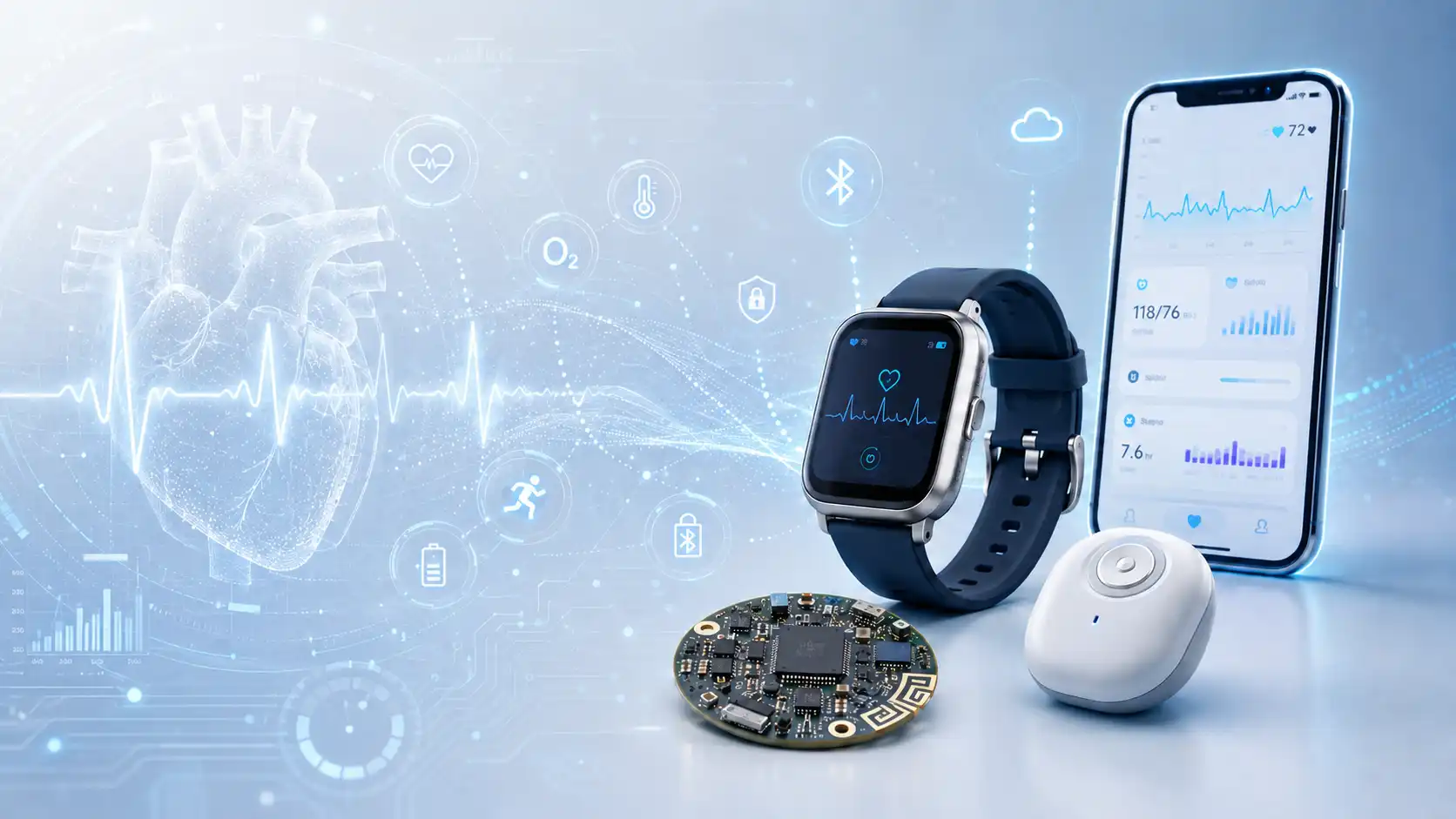
Why Use the EFR32BG26 for Wearable and Medical Devices?
The EFR32BG26 has a wireless radio operating at 2.4 GHz, as well as the powerful Arm Cortex-M33 microcontroller.
The device offers a variety of configurations featuring extensive program memory and RAM. Products using the EFR32BG26 can perform such functions as sensor data acquisition, Bluetooth operation, security features, local processing, user interface, and over-the-air firmware updates.
Its 78 MHz processor includes DSP instructions and a floating-point unit, which are useful when processing motion, physiological, or environmental sensor data. Selected devices also include hardware intended to accelerate AI and machine-learning workloads.
This can support applications such as activity classification, motion-pattern recognition, signal-quality assessment, and event detection directly on the device.
Local processing can reduce the amount of raw information transmitted over Bluetooth. Instead of continuously sending every sensor sample, a wearable may calculate metrics or identify meaningful events and transfer only the necessary results. This approach can reduce radio activity, improve responsiveness, and help keep sensitive data closer to the point of collection.
The EFR32BG26 also has Secure Vault features in the designated versions. These hardware-enabled technologies can prevent the exposure of device identities, crypto materials, firmware, and the process of communication.
Although the overall security is dependent on the whole architecture of the system, using an efficient hardware platform creates a good base for a medical device.
Project Case Study: EFR32BG26 Connected Patient Recovery Wearable
The Product Requirement
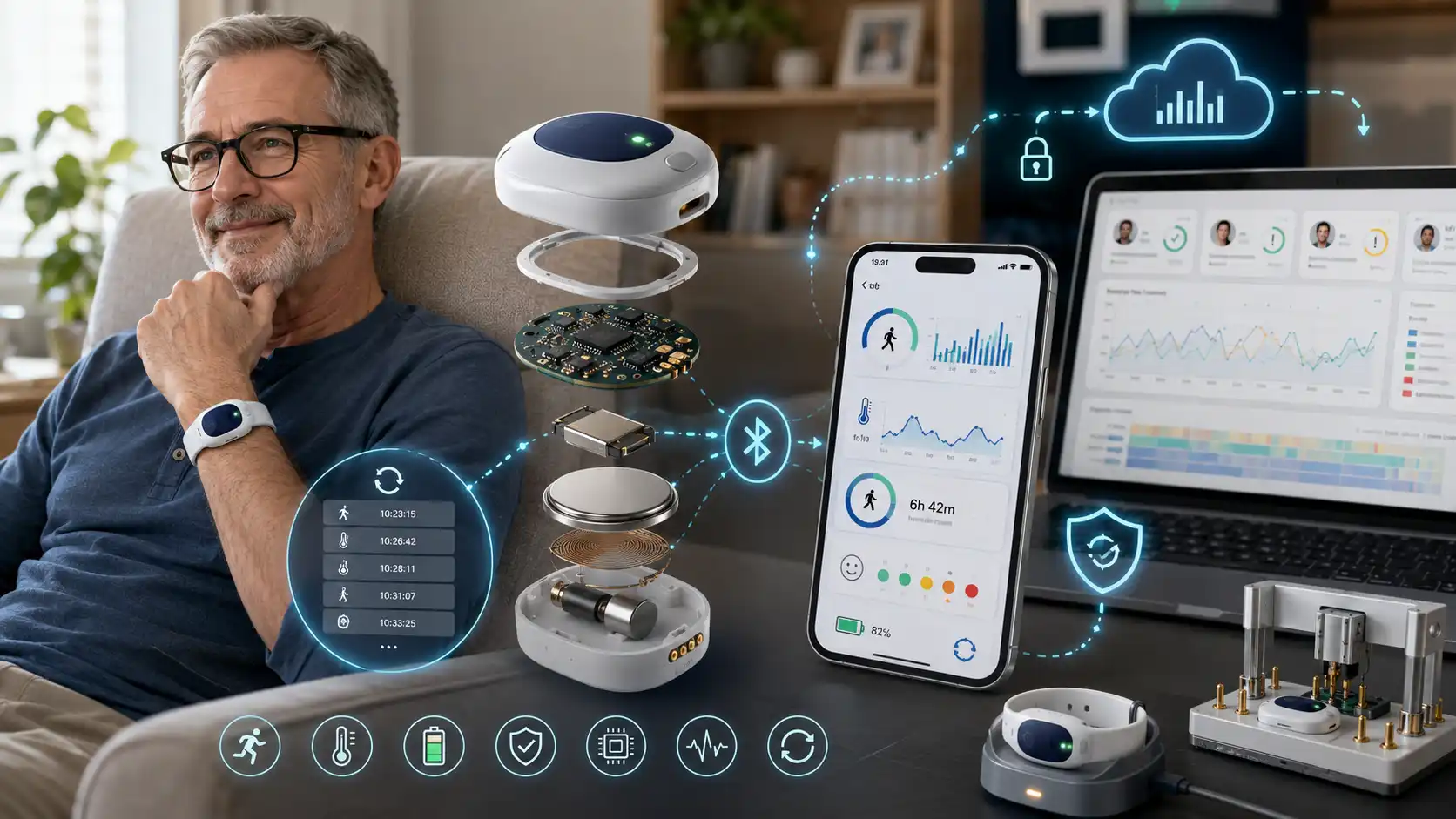
A healthcare technology company approached us to develop a compact wearable for monitoring patients during recovery at home. The product was intended to record movement, skin-temperature trends, device-wearing time, and user-triggered symptom events.
It also needed to synchronize information with a mobile application used by patients and a web dashboard used by authorized care teams.
The early prototype relied heavily on the phone and transmitted frequent streams of raw sensor data. This caused inconsistent battery performance and created synchronization problems whenever the phone was outside Bluetooth range.
The client wanted a more independent device that could continue collecting information offline and transfer it later without losing the sequence of events.
Hardware and Firmware Development
We selected the EFR32BG26 as the main wireless processor because the application needed Bluetooth Low Energy, local signal processing, secure device operation, and sufficient memory for future firmware growth.
Our hardware team designed a compact PCB with a three-axis motion sensor, digital temperature sensor, status LED, vibration motor, user button, battery measurement circuit, rechargeable battery, and protected charging interface.
Particular attention was given to antenna placement because the enclosure positioned the device close to the wearer's body.
On the firmware side, we implemented scheduled sensor sampling and a local event pipeline. Motion samples were filtered and converted into activity summaries rather than being transmitted continuously. Temperature measurements were checked for stability, while contact and movement indicators helped the application distinguish between a worn device and one left on a table.
A circular storage system retained measurements when the phone was unavailable. Each record included a sequence number and timestamp information, allowing the mobile application to identify missing blocks and resume synchronization after an interrupted transfer.
Bluetooth, Security, and Power Optimization
We created custom Bluetooth services for live status, historical record synchronization, configuration, diagnostics, battery reporting, and device updates.
The communication layer used acknowledgements and resumable transfers so that a brief disconnection did not require the complete dataset to be sent again.
We also implemented secure onboarding, device-specific identity handling, signed firmware-update controls, and restricted access to configuration characteristics.
Power profiling helped us adjust sensor duty cycles, advertising behaviour, connection parameters, storage operations, and LED usage.
Project Outcome
The completed prototype continued recording data without an active phone connection and synchronized stored records when the application returned.
Moving activity processing onto the wearable reduced routine Bluetooth traffic and improved the consistency of battery performance.
We delivered the PCB design package, embedded firmware, Bluetooth specification, mobile integration components, test documentation, manufacturing-test requirements, and an engineering prototype suitable for the client's next verification phase.
Security for Connected Medical Products
Medical and personal health information requires protection across the entire device ecosystem. We consider security during initial architecture rather than treating it as a final add-on.
Depending on the product, our implementation can include authenticated pairing, encrypted communication, unique device identities, protected key storage, secure boot, signed firmware images, rollback controls, role-based cloud access, audit records, and controlled device ownership transfer.
We also plan recovery paths. A product should behave predictably if an update is interrupted, storage becomes full, a sensor stops responding, or the mobile application sends an invalid request. These situations are uncommon during demonstrations but important during long-term use.
Prototype Testing and Production Preparation
We test the device as a complete system rather than evaluating the PCB, firmware, and mobile application separately.
Testing can include sensor verification, battery measurement, Bluetooth range, connection recovery, storage limits, update interruption, mobile compatibility, thermal behaviour, and extended operation.
In wearables, we also evaluate enclosure mechanisms, charging cycles, accidental presses, different body placement of devices, as well as repeated periods without phone connection efforts.
Prior to transferring production, we are able to prepare production firmware, programs of a device, serial-number processing, calibration, testing tools, inspection procedures, and production-support documents.
Where certification is required, we support pre-compliance planning and work with the customer's selected test laboratories. Certification requirements depend on the product, radio implementation, target market, intended use, and medical classification.
Our EFR32BG26 Development Services
Product Architecture and Technical Planning
We begin by converting the product idea into a practical engineering specification. Our team examines the target audience, requirements for the sensor, measurement frequency, mode of wireless transmission, power consumption, packaging constraints, mobile platform compliance as well as the level of cloud interaction and the anticipated environment in operation.
This stage helps us determine whether the EFR32BG26 is the correct choice and which device configuration is appropriate.
We also define the firmware architecture, Bluetooth data model, security approach, memory allocation, power states, update strategy, and interfaces between the embedded device, application, and backend.
For regulated products, we can structure development activities to support the customer's quality and documentation process. Final regulatory classification, clinical validation, and market authorization remain the responsibility of the product owner and relevant qualified specialists.
Custom Hardware and PCB Development
Our hardware engineers design compact electronics around the EFR32BG26 and the sensors required by the product.
The design may include optical sensing, temperature measurement, inertial sensing, pressure sensing, bio-potential acquisition, battery charging, haptic feedback, LEDs, displays, buttons, flash memory, and test interfaces.
Wearable PCB design requires careful component placement. Sensor precision may be compromised by electric noise, oscillation, temperature and even materials used in the enclosure of the device as well as by the battery's position. In addition, the performance of the Bluetooth antenna is likely to change a lot depending on the person wearing the device.
We therefore evaluate power integrity, grounding, antenna clearance, sensor placement, mechanical constraints, charging safety, and manufacturing test access as part of the design.
We also offer other services, which include design review and assembly, PCB layout, schematic capture, preparation of the bill of materials, prototype coordination, board bring-up, and assistance with revision.
EFR32BG26 Embedded Firmware Development
Using Silicon Labs development tools, we create modular firmware. Our firmware is suitable for sensor sampling, Bluetooth communication, local storage, alarms, power modes, diagnostics, interaction with users and updating solutions through the Internet.
Depending on the products we work with, we implement interrupt-controlled acquisition, scheduled measurements, changeable thresholds, event queues, circular data buffers, restoration of faults, control of watchdogs and management of timestamps.
We also build drivers for digital and analogue peripherals connected through interfaces such as I2C, SPI, UART, GPIO, ADC, and PWM.
When it comes to products that gather measurements continuously, we strive for a balance between speed and energy consumption. The peripherals along with sensors become active only when needed, and at the same time the radio and the processor operate in low-energy states for the most time.
Bluetooth Low Energy and Mobile App Development
Bluetooth engineering is not entirely about making devices available to mobile phones. For a Bluetooth device to be effective, it must have a good structure of GATT, use optimized sizes for packets, establish connection settings, ensure compatibility of versions, and comply with safety and reconnection protocols.
Our engineers create standard or custom Bluetooth services for measurements, device configuration, battery information, diagnostic logs, time synchronization, alerts, and firmware updates.
We test connection intervals, throughput, radio range, disconnections, background operation, and recovery when the wearable moves between connected and offline states.
In addition, we develop Android and iOS apps for onboarding, real-time data viewing, data history, alerts, user profiles, firmware updates, and account management.
When needed, we integrate the application with a secure cloud platform that provides physician dashboards, caregiver access, reporting, alerts, and connection to other systems.
Edge Intelligence and Sensor Data Processing
The raw output from a sensor is unable to be used because of possible interference from factors like motion, light, temperature, and body signals. These can result in interference from body movements, too little contact with the skin, light from outside the body, electric disturbance, or variations in how the device is worn.
According to the application, the firmware team creates filtering, calibration, baseline-tracking, sensor fusion, quality rating, and event detection algorithms.
If it is appropriate, we check if low-power machine learning can provide better classification or reduce excess transmissions over wireless connections.
We treat these algorithms separately from clinical claims. A technically working algorithm does not automatically establish medical accuracy. Any diagnostic or treatment-related output must be verified using appropriate datasets, validation procedures, and regulatory controls.
Build Your EFR32BG26 Wearable or Medical Device
Regardless of whether you are creating a health-monitoring wearable, rehabilitation gadget, portable medical device, patient-safety gadget, diagnostic instrument, or wellness platform, you need to know that Adequate Infosoft can be of help in creating a tested, production-ready product.
Get in touch with our EFR32BG26 development professionals to learn about your product needs, technical hurdles, prototype development process, and production direction.