














 Mean Stack Development
 Vue JS Development
 Javascript Development
 React JS Development
 Angular JS Development
 Next JS development
 Java Development
 Python Development
 Django Development
 Cherrypy Development
 C# Development
 ASP.NET Development
 NodeJS Development
 Laravel Development
 CodeIgniter Development
 Zend Development
 Ruby on Rails Development
 CakePHP Development
 PHP Website Development
 Symfony Development
 Drupal Development
 Joomla Development
 Wordpress Development
 .NET Nuke Development
 Kentico
 Umbraco
 .NET MAUI Development
 Xamarin Application Development
 iOS Application Development
 Android Application Development
 Android Wear App Development
 Ionic Development
 iBeacon Application Development
 Universal Windows Platform (UWP)
 Kotlin Application Development
 Swift Application Development
 Flutter Application Development
 PWA Application Development
 Flutter Health Tech & Wearable App Development Company
 React Native Health Tech Wearable App Development
 Offshore Software Development
 Custom Application Development
 Front-End Development
 Full Stack Development
 AI & Machine Learning
 Custom CRM Solutions
 Flask Software Development
 Electron JS Development
 ChatGPT Development
 Telemedicine App Development
 Build Smart Telemedicine Platform
 Beauty & Salon App Solutions
 Hire Workato Experts
 Magento Development
 Magento 2.0 Development
 Magento Enterprise
 Shopping Cart Development
 Prestashop Development
 Shopify Development
 Open Cart Development
 WooCommerce Development
 BigCommerce Development
 NopCommerce Development
 Virto Commerce Development
 AspDotNetStorefront Development
 .NET Application Development
 Microsoft Dynamics CRM
 VB .NET Development
 Sharepoint Migration
 ASP.NET Core Development
 ASP.NET MVC Development
 AJAX Development
 Agile Development
 Microsoft Bot
 Microsoft Blazor
 Microsoft Azure Cognitive
 HTML 5
 UI/UX Design
 Graphic Design
 Adobe Photoshop
 XML Application Development
 Cloud Computing Solutions
 Azure Cloud App Development
 AWS Development
 Google Cloud Development
 Certified AWS IoT Services Developers
 DevOps Consulting & Development
 Kubernetes Consulting & Services
 SQL Programming Development
 MySQL Development
 MongoDB Development
 Big Data
 Robotic Process Automation
 Social Media Marketing
 Search Engine Optimization
 QA Testing
 Software Testing
 Software Security
 Maintenance And Support
 I.T. Consulting Services
 Business Intelligence
 YII Development
 Data Analysis
 Alexa Skills Development
 On Demand App for Mobile repairing services
 On Demand App for Car Service Booking
 On Demand App for Cleaning Services
 On Demand App for Pharmacy
 On Demand Dedicated Developers
 On Demand Lawyer App Development









 Nuki Smart Lock
 Salto Smart Lock
 TTlock Smart Lock
 NFC App Development
 Custom IOT Enabled Smart Lock
 Smart Locker Solutions
 Hospital Smart Lock Systems
 Hotel Smart Lock Systems
 Smart Home & Office Locks
 Smart Access for Schools & Colleges
 Unloc Smart Lock Integration
 Yale & August Smart Lock Integration
 Populife Smart Lock Integration
 Smart Lock Hardware Development
 Dairy IoT Solutions
 Agri IoT & AI Solutions
 Weather & Climate Solutions
 Water & Waste Management Solutions
 RaspBerry Pi
 Firmware Software Development
 ESP 32 Software Development
 Embedded Development
 Internet of Things
 Smart IoT Development
 IoT Sensor Integration & Development Solutions
 Smart IoT System Development for HVAC
 Tuya IoT App Development
 Particle IoT SDK
 IoT Development with AI
 Smart Pet GPS Tracker
 Dairy GPS Tracking Solutions
 GPS Fleet Management Software
 Car Rental & Subscription Solutions
 Car Buy & Sell Marketplace Development
 AI-Powered Car Wash App Development
 PCB Design & Fabrication
 IoT AC Automation
 AI–IoT Painting Solutions
 IoT Wearable Hardware & App Development
 HVAC Automation & AI Control Systems
 Smart Home IoT Engineering
 AI Embedded Systems
 AI Hardware Design Service
 Advanced IoT Hardware & Firmware Development
 Device Driver Development Services
 NXP i.MX RT Firmware & Hardware Services
 Microchip PIC & AVR Development
 Hire IoT Architects
 IoT Cloud & Infrastructure Solutions
 Infineon XMC / AURIX Development Services
 Matter & Thread IoT Services
 Native IoT Mobile App Development (BLE & Wi-Fi)
 Snapdragon IoT Firmware Development
 Renesas RA/RX Firmware Services
 Silicon Labs EFR32 Development Services
 Smart Wearable App Development
 Smart IoT Meters
 Smart Healthcare Wearable App Development
 Health Care Monitoring System
 Fitness Tracking App Development
 Smart Home Automation Apps
 nRF PCB Design
 ESP32 PCB Design
 Embedded Wearables Engineers
 Rental Property Management System
 Building Management System
 Smart Lighting Development
 Infineon Semiconductor Firmware Development Services
 Custom Camera Development: Hardware, Firmware & PCB Prototyping
 Smart Security Camera SDK
 Nordic Semiconductor SDK
 Infineon SDK
 Arduino SDK
 NFC Lock Integration
 Kerong Lock Integration
 IoT & AI Solutions for Manufacturing
 Smart Inventory & Logistics Solution
 Food & Beverage Industry Solutions
 Smart Hospitality Solutions
 Smart Property Management
 Custom Smart Home IOT SDK
 Smart IoT & AI in Healthcare
 AI-Powered Security Solutions
 Smart Home Safety & AI
 Veterinary Clinic Management (AI)
 Pet Care System (AI & IoT)
 Pet Training & Adoption (AI)
 Healthcare IoT Development
 Event Management Software
 Money Remittance App
 Money Lending App Development
 Utility and Bill Payment App
 IoT Mobile App Development (Flutter & React Native)
 AI & IoT Retail Solutions
 Smart EV App Development
 Smart Solar IoT & AI Solutions
 IoT-Based Energy Systems
 Smart Energy & Utilities Solutions
 6G Solutions
 IoT Security Solutions
 AI-Powered Lottery App Development
 AI-Sports Fitness Club Management
 Travel
 Real Estate
 Medical & Healthcare
 e-Learning
 Consumer Products
 Finance
 Automobile
 Media & Entertainment
 Billing Software
 Enterprise Resource Planning (ERP)
 Augumented & Virtual Reality
 Point of Sale(POS) Development
 Learning Management System
 EV Charging Solutions
 About Us
 Partners & Certifications
 Quality Assurance
 Our Clients & Testimonials
 Development Process
 Our Products
 Social Responsibility
 Work Ethics
 Vision & Mission
 Awards
 Live Project Demos
 Contact Us
 Case Studies
 Portfolio
 Blog
Blog
Bluetooth Electronic Shelf Label Development Services with nRF54L & PAwR
Adequate Infosoft develops Bluetooth Electronic Shelf Label (ESL) solutions using Nordic nRF54L Series SoCs, Bluetooth Low Energy, Periodic Advertising with Responses (PAwR), and the Bluetooth ESL Profile.
We support the development of battery-powered digital shelf labels, ESL access points, display firmware, device provisioning, retail-system integration, fleet management, and production-ready embedded platforms.
Electronic shelf labels have distinct specifications compared to traditional BLE devices. Retail establishments can employ hundreds or thousands of battery-operated electronic tags that are used to receive pricing, stock information, marketing details, or product specifics while operating mostly in ultra-low-power mode.
While Bluetooth PAwR is developed for one-to-many communication synchronization, the Bluetooth ESL Profile defines standard application-level protocols for controlling and managing ESL systems.
We see ESL development as a coherent system since it includes everything from tag electronics, RF, firmware, display management to wireless scheduling and security and access point application software and APIs as well as retail integration software.
Let's Work Together!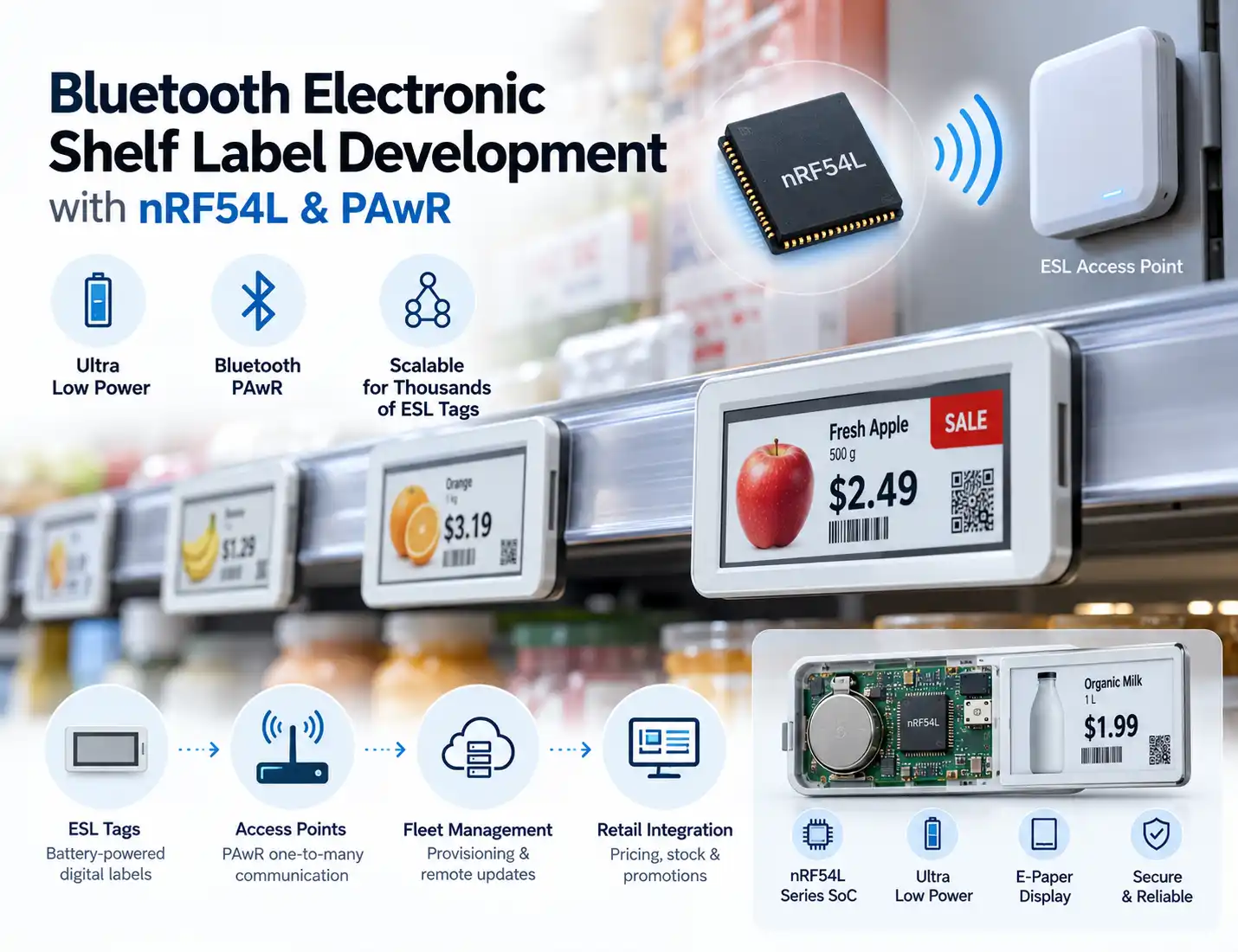
What are the Advantages of Using nRF54L for Electronic Shelf Labels?
nRF54L15 is a wireless SoC with low energy consumption powered by 128 MHz Arm Cortex-M33 processor. It has also 1.5 MB of non-volatile memory, 256 MB of RAM, and 2.4 GHz radio. The Nordic manufacturers have specifically indicated that the nRF54L series supports Bluetooth capabilities including Bluetooth PAwR and ESL profile.
This means that this device is a convenient tool for ESL design that requires handling data transmission wirelessly, managing display features, monitoring batteries, ensuring security, etc., inside one small embedded product.
Moreover, nRF54L15 has a variety of features such as an advanced security system, various serial connections, ADC, timers, PWM, etc.
However, selecting the SoC is only one part of the engineering decision. Display type, refresh frequency, battery capacity, antenna design, store environment, tag density, update latency, enclosure, and access-point placement all influence the final design.
Bluetooth ESL and PAwR Development
Periodic Advertising with Responses (PAwR) is especially applicable when it comes to electronic shelf labels since it allows synchronous and connectionless one-to-many communication.
Instead of being connected through individual conventional BLE connection to each label, an access point can broadcast periodic advertising messages and give opportunities to respond to those devices in a synchronized manner.
According to Nordic's ESL materials, PAwR and Encrypted Advertising Data can be utilized in situations when an access point has to handle large quantities of low-energy ESL devices.
The Bluetooth ESL Profile builds application-level behavior on top of Bluetooth LE. The Bluetooth SIG defines it as the mechanism through which a GATT Client can control and update electronic shelf labels using Bluetooth wireless technology.
The standardized profile is intended to support interoperability within the ESL ecosystem.
Our development work can cover PAwR synchronization, ESL addressing, response-slot handling, command processing, acknowledgement logic, display updates, and device-state management.
nRF54L ESL Firmware Development
We develop ESL tag firmware around the real operating cycle of a retail label.
The common features of firmware include:
Device Onboarding and Setup
Basic identification and setup of each device.
Synchronization with PAwR
Proper joining of devices into an active periodic advertising system and subsequent synchronization.
Processing ESL Commands
Successfully receiving and executing commands.
Display Management
Controlling images and display management, and solving problems related to display failure.
Battery Management
Monitoring the battery status and ensuring that low power conditions are communicated to the management.
Local Control Methods
Activation of buttons, sensors, indications, and all inputs related to the particular product.
Diagnosis and Recovery
Overcoming the failures of updates, reset commands and communication.
OTA Firmware Upgrades
Successful updating of firmware during maintenance.
Power management is a central part of the architecture. The tag should remain inactive whenever no useful work is required and wake according to its communication schedule, process the required data, update the display when necessary, and return to a low-power state.
Relevant Adequate Infosoft Nordic Experience
Adequate Infosoft has developed multiple Nordic-based BLE and low-power embedded products, providing relevant engineering experience for ESL projects.
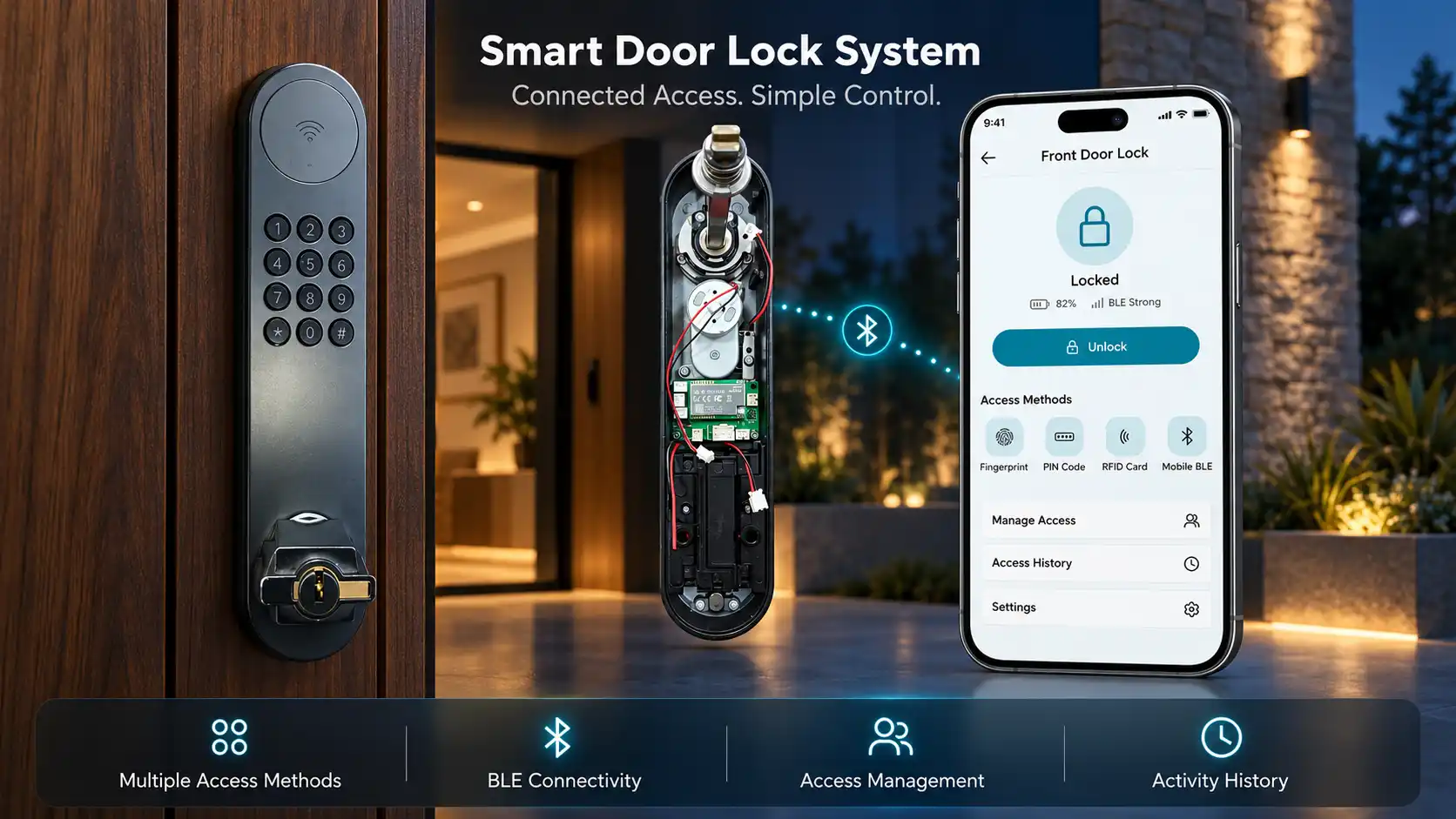
Nordic nRF52-Powered BLE Smart Lock
Our BLE smart-lock project used Nordic nRF52840 hardware, a custom four-layer PCB, low-power motor control, battery management, secure BLE communication, OTA support, and mobile/cloud integration. Advanced firmware versions used Nordic nRF5 SDK and Zephyr.
Although this was not an ESL project, it demonstrates relevant experience in secure BLE communication, event-driven firmware, low-power operation, custom Nordic hardware, and production-oriented development.
Read Case Study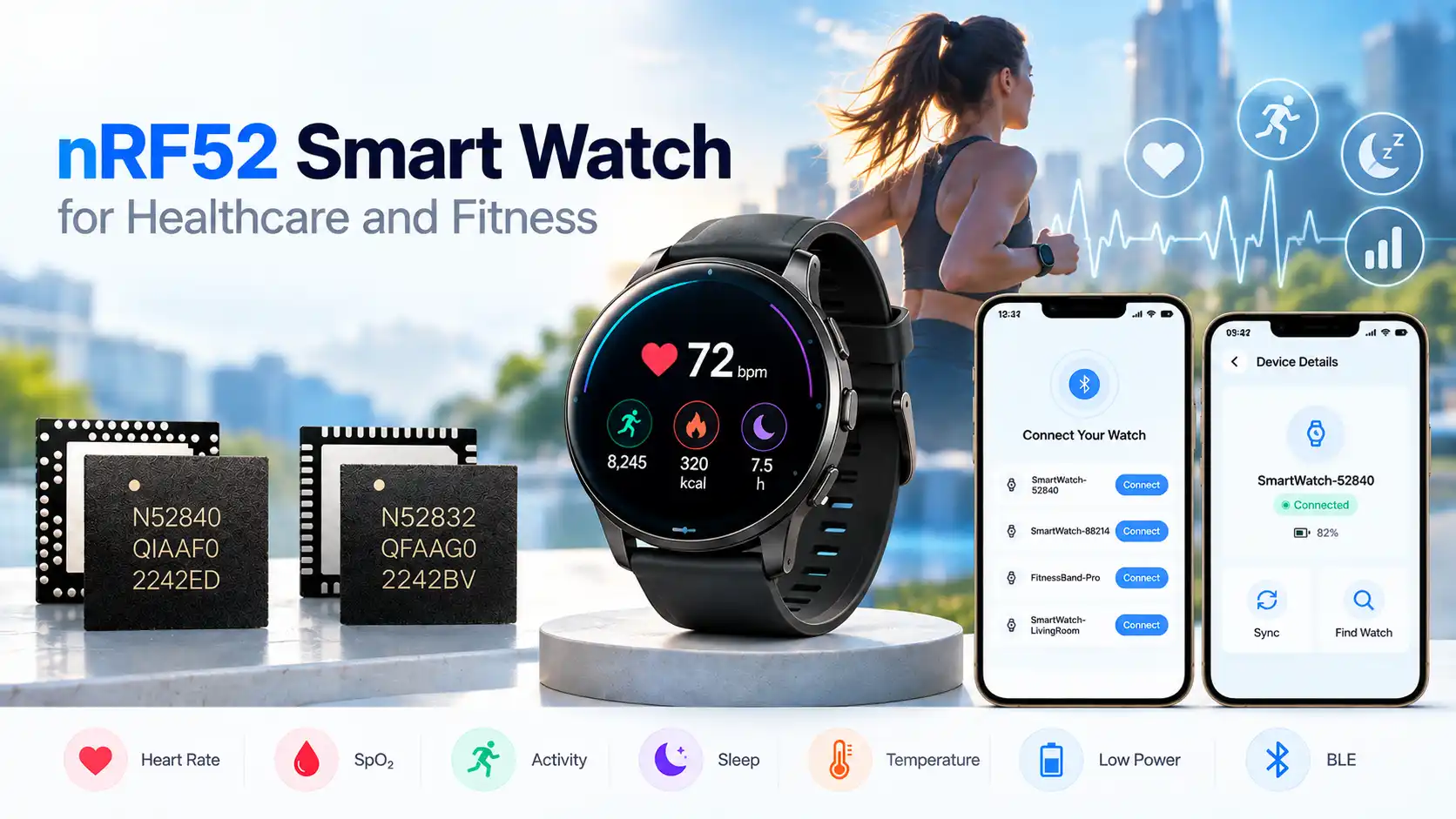
nRF52 Smart Watch for Healthcare and Fitness
Adequate Infosoft developed a production-oriented smartwatch using Nordic nRF52832 and nRF52840 devices. The project included low-power RTOS firmware, BLE communication, sensor integration, power-state management, custom RF hardware, and manufacturing-ready prototypes.
These capabilities are transferable to ESL tags where compact hardware, predictable BLE behavior, and aggressive power management are equally important.
Read Case Study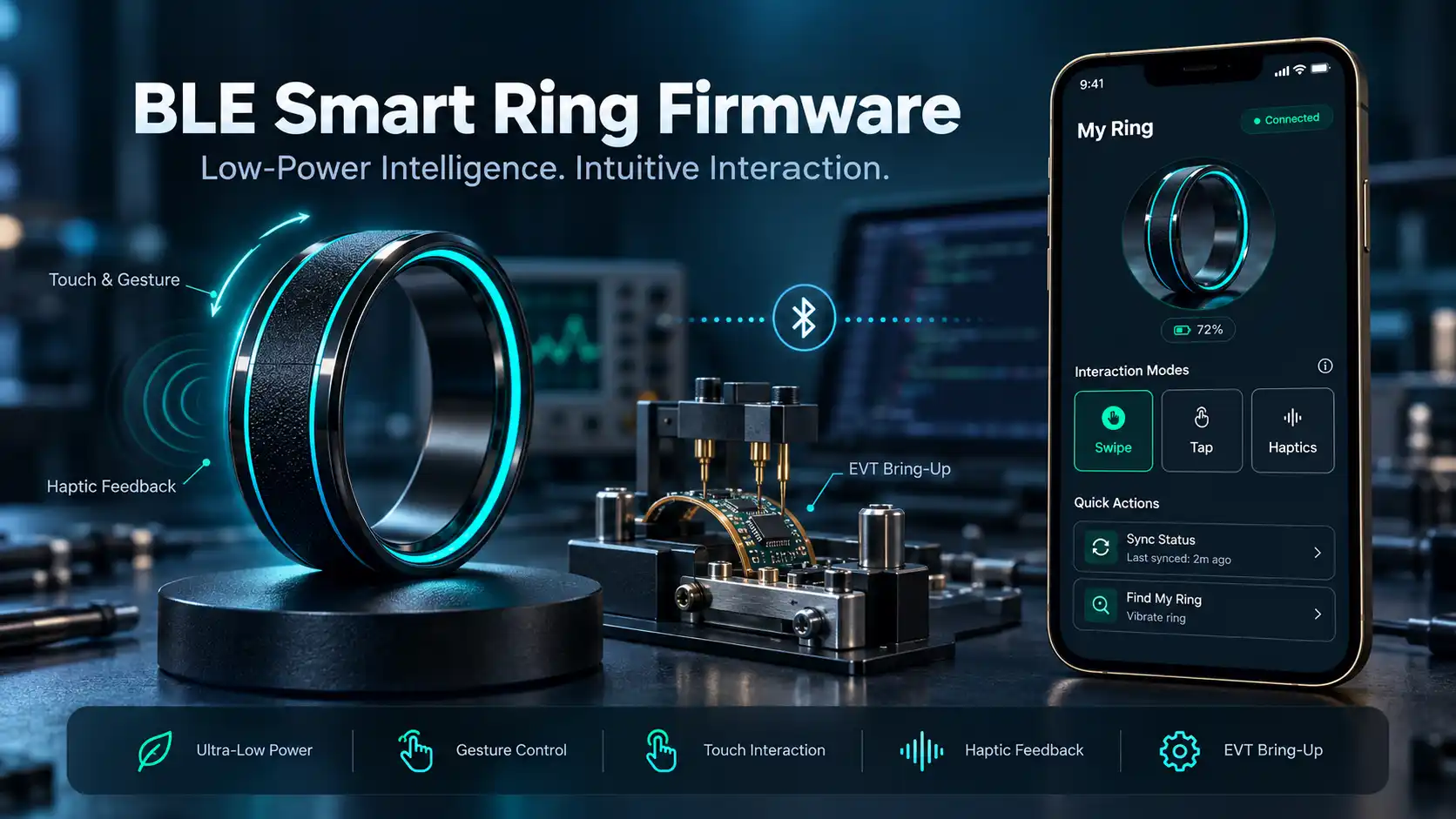
BLE Smart Ring with Nordic nRF52
Our Nordic BLE smart-ring project focused on compact embedded hardware, gesture recognition, touch interaction, haptic feedback, BLE communication, low-power optimization, and EVT bring-up.
The project demonstrates experience with the same class of constraints found in small ESL devices: limited physical space, battery operation, event-driven firmware, wireless communication, and careful power optimization.
Read Case StudyThese case studies demonstrate relevant Nordic and BLE engineering experience. They are not represented as nRF54L or Bluetooth ESL implementations unless explicitly identified as such.
E-Paper and Display Integration
The display subsystem is one of the most important ESL-specific engineering areas. E-paper technology is particularly attractive for many shelf labels because the image can remain visible without continuously refreshing the display.
We integrate display controllers with nRF54L firmware and can build image-processing pipelines for product prices, promotional messages, product identifiers, barcodes, QR codes, icons, and other retail information.
Development may include full and partial refresh strategies, frame-buffer management, image compression or conversion, font rendering, display-driver integration, and handling of incomplete or interrupted updates.
The software architecture can connect the retail backend to the display pipeline so that a price or promotion change is transformed into the appropriate label image or command before being transmitted to the target ESL.
Low-Power ESL Design
One of the fundamental requirements for design of electronic shelf labels is battery life. Hence, wireless communication must be designed properly according to the wakeup and update cycles.
Among those optimized are:
PAwR timings and receive windows Sleep and active mode states Display refresh CPU activity Memory reaching Peripheral usage Battery check Retrial behavior Firmware logging
The nRF54L Series is intended for low power wireless operation, with Nordic identifying the nRF54L15 as exceptionally low power SoC. Its radio and processor architecture contains everything necessary to support battery-powered equipment while being energy efficient.
These assumptions are confirmed on the basis of actual hardware rather than simply relying on theoretical values. Current profiling, timing of communication, display behavior, and battery discharge are combined in order to make the final assessment of practical operating time of the label.
ESL Access Point and One-to-Many Communication
A production ESL system normally includes three major layers: the ESL tag, the access point, and the retail management platform.
The access point schedules communication with tags, handles wireless traffic, manages synchronization, tracks responses, and forwards application information between the ESL network and the retailer's backend.
We can develop or integrate access-point software using embedded Linux, gateway platforms, Nordic development hardware, or other suitable computing systems.
For larger deployments, communication scheduling becomes important. A practical system needs to support device grouping, queued updates, retry handling, acknowledgements, unavailable tags, and priority-based updates.
For example, an urgent pricing correction may need to take precedence over a routine synchronization task. The management layer can also identify labels that repeatedly fail to update and flag them for store-level investigation.
Retail Backend and Fleet Management
The ESL system is not just a label. The software necessary for all ESL functionality needs to connect all data within an organization across existing systems.
Integration with POS, ERP, inventory and pricing management systems can be accomplished by means of REST APIs, MQTT, webhooks, and other similar technologies.
The following is an illustration of how that works in practice:
A price changes inside the retailer's system and goes into the device update queue. The defined access point finds the required device and establishes communication. The ESL receives the update, processes it, and confirms success.
The backend can keep track of the device ID, firmware version, battery state, last communication date and time, update status, and additional conditions.
This makes the ESL solution a fleet of devices instead of a set of independent beacons.
Security in Bluetooth ESL Systems
Security is crucial as an unauthorized change in a price or promotion can lead to serious business disruptions.
Ensuring security in Bluetooth ESL systems requires the use of Encrypted Advertising Data (EAD), while implementing provisioning with security components, credential protection, authenticated firmware upgrades, authorization at the application level, and key management practices.
nRF54L15 also has several features that could protect hardware, such as Arm TrustZone, tamper detection, and cryptography with side-channel protection.
Moreover, communication security is regarded as different from business authorization. Even though the data was found to be secure, the application still has to ensure that the sender and command that have reasonable requests are allowed to change a particular tag or store.
PCB, RF and Hardware Development
Adequate Infosoft can support the complete embedded hardware surrounding the nRF54L15.
The engineering areas include:
PCB
Design of optimized compact multilayer structures of circuits capable of implementing the SoC, monitor, the battery, various sensors, and any outer circuits needed.
RF Design
Usage of antenna structures, placements of such antennas, PCB grounding, RF routing, and performance validation process.
Power Design
Design of the battery interface with all regulators, charging units, and measuring instruments.
Display Circuit
Implementation of the paper-like display interface.
Production Interface
Programming of devices, debugging devices, testing points, manufacturing systems, and programming diagnostic systems.
In general, nRF54L15 utilizes a single-ended antenna output with the integrated balun but it is worth mentioning that the real RF performance depends on how the antenna is designed and how the PCB implementation and other adjacent components will be used.
From ESL Prototype to Production
We provide comprehensive support for ESL programs, starting with the initial proof of concept and moving forward through engineering production.
On the development path, we can assist with different areas such as the system architecture, nRF54L evaluation, PAwR implementation, Bluetooth ESL integration, display selection, PCB design, firmware, an access-point software, retail APIs, and security architecture, among others.
When it comes to the prototype, the main focus is on demonstrating the PAwR communication and display control. In the case of a production rollout, however, the focus shifts to achieving tag density, reliability, battery life, fleet management, secure updates, manufacturing repeatability, and long-term maintainability.
Why Choose Adequate Infosoft?
Adequate Infosoft combines embedded firmware, Nordic BLE development, PCB and RF engineering, mobile applications, backend development, cloud integration, and IoT product engineering.
ESL can't be thought of as simply another standalone product. Its various components of communication protocol, display, battery, access point, back end, retail information, security controls, and manufacturing all need to act together as one combined system.
We're able to work towards measurable engineering targets, such as battery life, update latency, communication reliability, tag density, display refresh, recovery performance and testing of manufacturing.
We can assist with an nRF54L15 PAwR proof of concept, Bluetooth ESL firmware, custom electronic shelf label hardware, ESL access points, e-paper solutions, and its entire architecture and production.
Frequently Asked Questions
Bluetooth Electronic Shelf Label refers to a digital shelf showcasing device that can be wirelessly controlled and updated. The Bluetooth ESL Profile describes the standardized methods for controlling and updating the ESL devices.
PAwR stands for Periodic Advertising with Responses. It enables synchronized one-to-many Bluetooth LE communication in which devices can receive periodic advertising data and respond during defined response opportunities.
The nRF54L15 combines a 128 MHz Cortex-M33 processor, substantial memory, a low-power 2.4 GHz multiprotocol radio, advanced security features, and Bluetooth PAwR/ESL support.
Yes. Development consists of tag firmware based on the nRF54L, PAwR communication, Bluetooth ESL logic, display integration, access point software, backend API, and fleet management platform.
PAwR was designed for synchronization of one-to-many applications and is used as basis for creating Bluetooth ESL architecture where access point communicates with numerous low-power tags.
The real capacity of the system correlates with communication scheduling, the density of tags, the quality of radio connection, timing, data of the application, and deployment architecture.