









 Mean Stack Development
 Vue JS Development
 Javascript Development
 React JS Development
 Angular JS Development
 Next JS development
 Java Development
 Python Development
 Django Development
 Cherrypy Development
 C# Development
 ASP.NET Development
 NodeJS Development
 Laravel Development
 CodeIgniter Development
 Zend Development
 Ruby on Rails Development
 CakePHP Development
 PHP Website Development
 Symfony Development
 Drupal Development
 Joomla Development
 Wordpress Development
 .NET Nuke Development
 Kentico
 Umbraco
 .NET MAUI Development
 Xamarin Application Development
 iOS Application Development
 Android Application Development
 Android Wear App Development
 Ionic Development
 iBeacon Application Development
 Universal Windows Platform (UWP)
 Kotlin Application Development
 Swift Application Development
 Flutter Application Development
 PWA Application Development
 Flutter Health Tech & Wearable App Development Company
 React Native Health Tech Wearable App Development
 Offshore Software Development
 Custom Application Development
 Front-End Development
 Full Stack Development
 AI & Machine Learning
 Custom CRM Solutions
 Flask Software Development
 Electron JS Development
 ChatGPT Development
 Telemedicine App Development
 Build Smart Telemedicine Platform
 Beauty & Salon App Solutions
 Hire Workato Experts
 Magento Development
 Magento 2.0 Development
 Magento Enterprise
 Shopping Cart Development
 Prestashop Development
 Shopify Development
 Open Cart Development
 WooCommerce Development
 BigCommerce Development
 NopCommerce Development
 Virto Commerce Development
 AspDotNetStorefront Development
 .NET Application Development
 Microsoft Dynamics CRM
 VB .NET Development
 Sharepoint Migration
 ASP.NET Core Development
 ASP.NET MVC Development
 AJAX Development
 Agile Development
 Microsoft Bot
 Microsoft Blazor
 Microsoft Azure Cognitive
 HTML 5
 UI/UX Design
 Graphic Design
 Adobe Photoshop
 XML Application Development
 Cloud Computing Solutions
 Azure Cloud App Development
 AWS Development
 Google Cloud Development
 Certified AWS IoT Services Developers
 DevOps Consulting & Development
 Kubernetes Consulting & Services
 SQL Programming Development
 MySQL Development
 MongoDB Development
 Big Data
 Robotic Process Automation
 Social Media Marketing
 Search Engine Optimization
 QA Testing
 Software Testing
 Software Security
 Maintenance And Support
 I.T. Consulting Services
 Business Intelligence
 YII Development
 Data Analysis
 Alexa Skills Development
 On Demand App for Mobile repairing services
 On Demand App for Car Service Booking
 On Demand App for Cleaning Services
 On Demand App for Pharmacy
 On Demand Dedicated Developers
 On Demand Lawyer App Development






 Nuki Smart Lock
 Salto Smart Lock
 TTlock Smart Lock
 NFC App Development
 Custom IOT Enabled Smart Lock
 Smart Locker Solutions
 Hospital Smart Lock Systems
 Hotel Smart Lock Systems
 Smart Home & Office Locks
 Smart Access for Schools & Colleges
 Unloc Smart Lock Integration
 Yale & August Smart Lock Integration
 Populife Smart Lock Integration
 Smart Lock Hardware Development
 Dairy IoT Solutions
 Agri IoT & AI Solutions
 Weather & Climate Solutions
 Water & Waste Management Solutions
 RaspBerry Pi
 Firmware Software Development
 ESP 32 Software Development
 Embedded Development
 Internet of Things
 Smart IoT Development
 IoT Sensor Integration & Development Solutions
 Smart IoT System Development for HVAC
 Tuya IoT App Development
 Particle IoT SDK
 IoT Development with AI
 Smart Pet GPS Tracker
 Dairy GPS Tracking Solutions
 GPS Fleet Management Software
 Car Rental & Subscription Solutions
 Car Buy & Sell Marketplace Development
 AI-Powered Car Wash App Development
 PCB Design & Fabrication
 IoT AC Automation
 AI–IoT Painting Solutions
 IoT Wearable Hardware & App Development
 HVAC Automation & AI Control Systems
 Smart Home IoT Engineering
 AI Embedded Systems
 AI Hardware Design Service
 Advanced IoT Hardware & Firmware Development
 Device Driver Development Services
 NXP i.MX RT Firmware & Hardware Services
 Microchip PIC & AVR Development
 Hire IoT Architects
 IoT Cloud & Infrastructure Solutions
 Infineon XMC / AURIX Development Services
 Matter & Thread IoT Services
 Native IoT Mobile App Development (BLE & Wi-Fi)
 Snapdragon IoT Firmware Development
 Renesas RA/RX Firmware Services
 Silicon Labs EFR32 Development Services
 Smart Wearable App Development
 Smart IoT Meters
 Smart Healthcare Wearable App Development
 Health Care Monitoring System
 Fitness Tracking App Development
 Smart Home Automation Apps
 nRF PCB Design
 ESP32 PCB Design
 Embedded Wearables Engineers
 Rental Property Management System
 Building Management System
 Smart Lighting Development
 Infineon Semiconductor Firmware Development Services
 Custom Camera Development: Hardware, Firmware & PCB Prototyping
 Smart Security Camera SDK
 Nordic Semiconductor SDK
 Infineon SDK
 Arduino SDK
 NFC Lock Integration
 Kerong Lock Integration
 IoT & AI Solutions for Manufacturing
 Smart Inventory & Logistics Solution
 Food & Beverage Industry Solutions
 Smart Hospitality Solutions
 Smart Property Management
 Custom Smart Home IOT SDK
 Smart IoT & AI in Healthcare
 AI-Powered Security Solutions
 Smart Home Safety & AI
 Veterinary Clinic Management (AI)
 Pet Care System (AI & IoT)
 Pet Training & Adoption (AI)
 Healthcare IoT Development
 Event Management Software
 Money Remittance App
 Money Lending App Development
 Utility and Bill Payment App
 IoT Mobile App Development (Flutter & React Native)
 AI & IoT Retail Solutions
 Smart EV App Development
 Smart Solar IoT & AI Solutions
 IoT-Based Energy Systems
 Smart Energy & Utilities Solutions
 6G Solutions
 IoT Security Solutions
 AI-Powered Lottery App Development
 AI-Sports Fitness Club Management
 Travel
 Real Estate
 Medical & Healthcare
 e-Learning
 Consumer Products
 Finance
 Automobile
 Media & Entertainment
 Billing Software
 Enterprise Resource Planning (ERP)
 Augumented & Virtual Reality
 Point of Sale(POS) Development
 Learning Management System
 EV Charging Solutions
 About Us
 Partners & Certifications
 Quality Assurance
 Our Clients & Testimonials
 Development Process
 Our Products
 Social Responsibility
 Work Ethics
 Vision & Mission
 Awards
 Live Project Demos
 Contact Us
 Case Studies
 Portfolio
 Blog
Blog
Bluetooth Channel Sounding & Secure Ranging Development with nRF54L
Adequate Infosoft provides Bluetooth Channel Sounding development services with Nordic nRF54L for distance-aware, secure and low-power products.
We develop ranging architecture, firmware, RF hardware, algorithms, mobile integration, testing and production support.
Bluetooth Channel Sounding, introduced in Bluetooth Core 6.0, brings fine ranging into the Bluetooth ecosystem. Instead of treating received signal strength as a rough proxy for proximity, two compatible devices measure characteristics of the radio channel and calculate their separation.
This can enhance digital keys, smart locks, object trackers, access devices, industrial security systems and human-machine interfaces without the addition of an extra ranging radio.
The accuracy varies with antenna positioning, human body and other surrounding elements like walls, metal, reflections and interferences therefore we need to verify the entire ranging system in the specified surroundings.
Let's Work Together!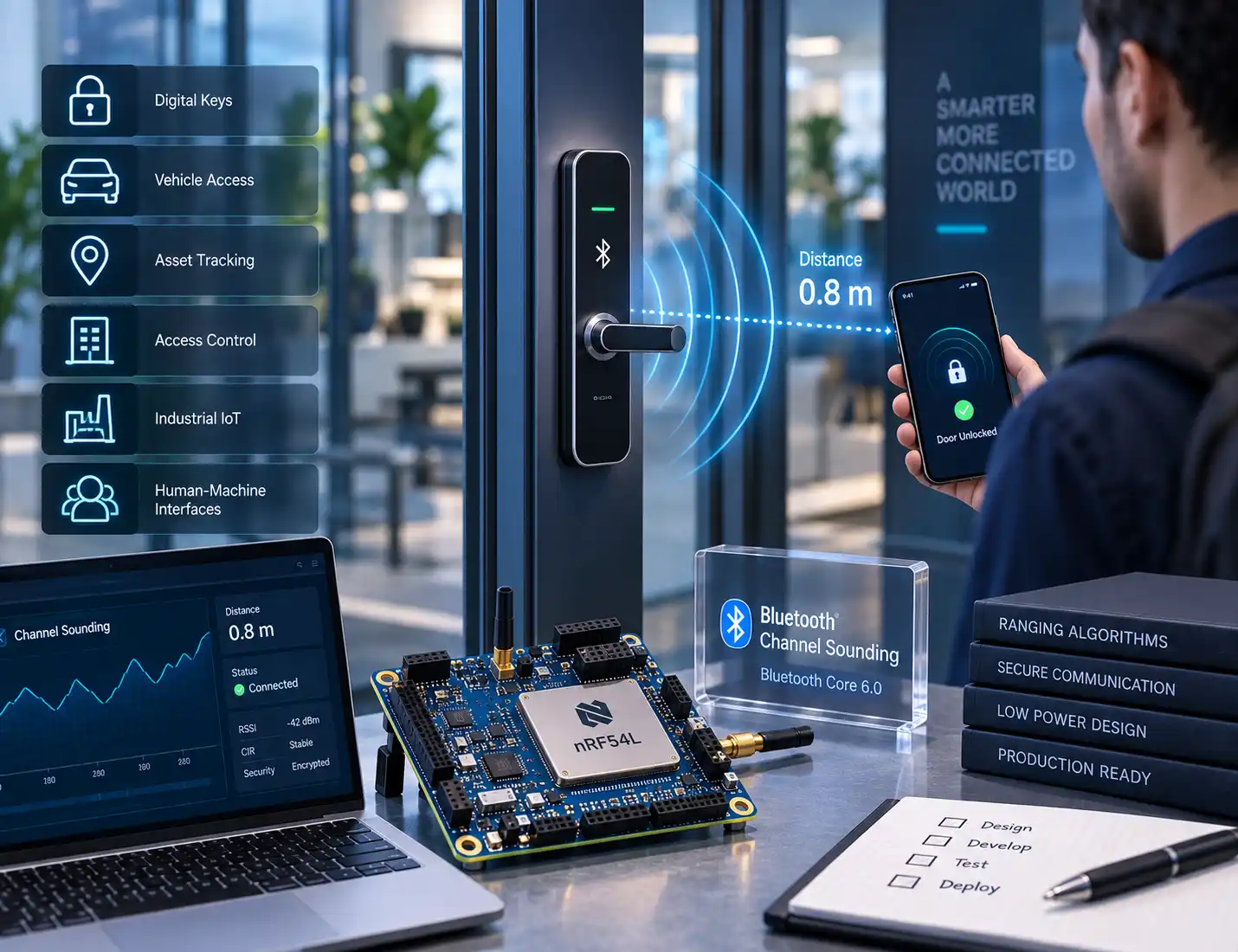
What Is Bluetooth Channel Sounding?
Bluetooth Channel Sounding is a safe, advanced technology for measuring the distance between two Bluetooth Low Energy devices. One device serves as the initiator and another acts as the reflector.
They send signals over different radio frequencies to take readings that are transformed into distance by the using of a ranging algorithm.
The technology uses two complementary methods:
- Phase-Based Ranging (PBR) The initiator sends a signal that the reflector returns. Repeating this process across multiple frequencies reveals phase differences that can be used for high-accuracy distance estimation.
- Round-Trip Time (RTT) The system measures the travel time of cryptographically scrambled exchanges. RTT supplies an independent distance bound and helps detect sophisticated man-in-the-middle relay attempts.
PBR supports precise measurement, while RTT adds security-oriented cross-checking. The Bluetooth SIG reports early accuracy around ±20 cm and potential range up to 150 metres under favourable conditions. These are technology-level expectations, not product guarantees. Enclosure, antennas, multipath, orientation, calibration and algorithms determine performance.
Bluetooth does not establish a single distance-calculating algorithm that could be applied to all devices. Instead, it formalizes the metrics according to which the approximate distance can be calculated. This opens possibilities for the developers but complicates the task of developing algorithms, its validation and adjustment for each product.
Why Use the Nordic nRF54L Platform?
The nRF54L Series combines a low-power multiprotocol radio, efficient processing and modern security. The nRF54L15 provides a 128 MHz Arm Cortex-M33, 1.5 MB non-volatile memory, 256 KB RAM and a RISC-V coprocessor. It supports Bluetooth LE, Channel Sounding, Matter, Thread, Zigbee and proprietary 2.4 GHz.
Nordic has mentioned a 3.4mA receive current from nRF54L15 Tag while the transmit current is 4.8mA at 0dBm. Sleep states commence from just 0.7 μA at 3V.
The actual consumption is dependent upon the range schedule, amount of connected devices, sensors and power design.
The nRF54L15 Tag is a great example of a reference platform. It is designed in a coin-cell and contains sensors and two antennas making it possible for development teams to analyze trackers/wearables before custom hardware.
Using dual antennas is an advantage in situations where positions of the body or its obstructing parts lead to the interruption of the RF path.
Relevant Adequate Infosoft Case Studies
Explore real-world embedded, IoT, and software projects delivered by Adequate Infosoft. Our case studies provide insights into the approaches our engineering team has taken when handling various product development tasks.
Our projects range from hardware and firmware development through connectivity, cloud integration, and software applications and showcase our expertise in all technologies and product specifications.
The solutions we have created illustrate how we are able to create, test, integrate, and validate the efficiency of our products.
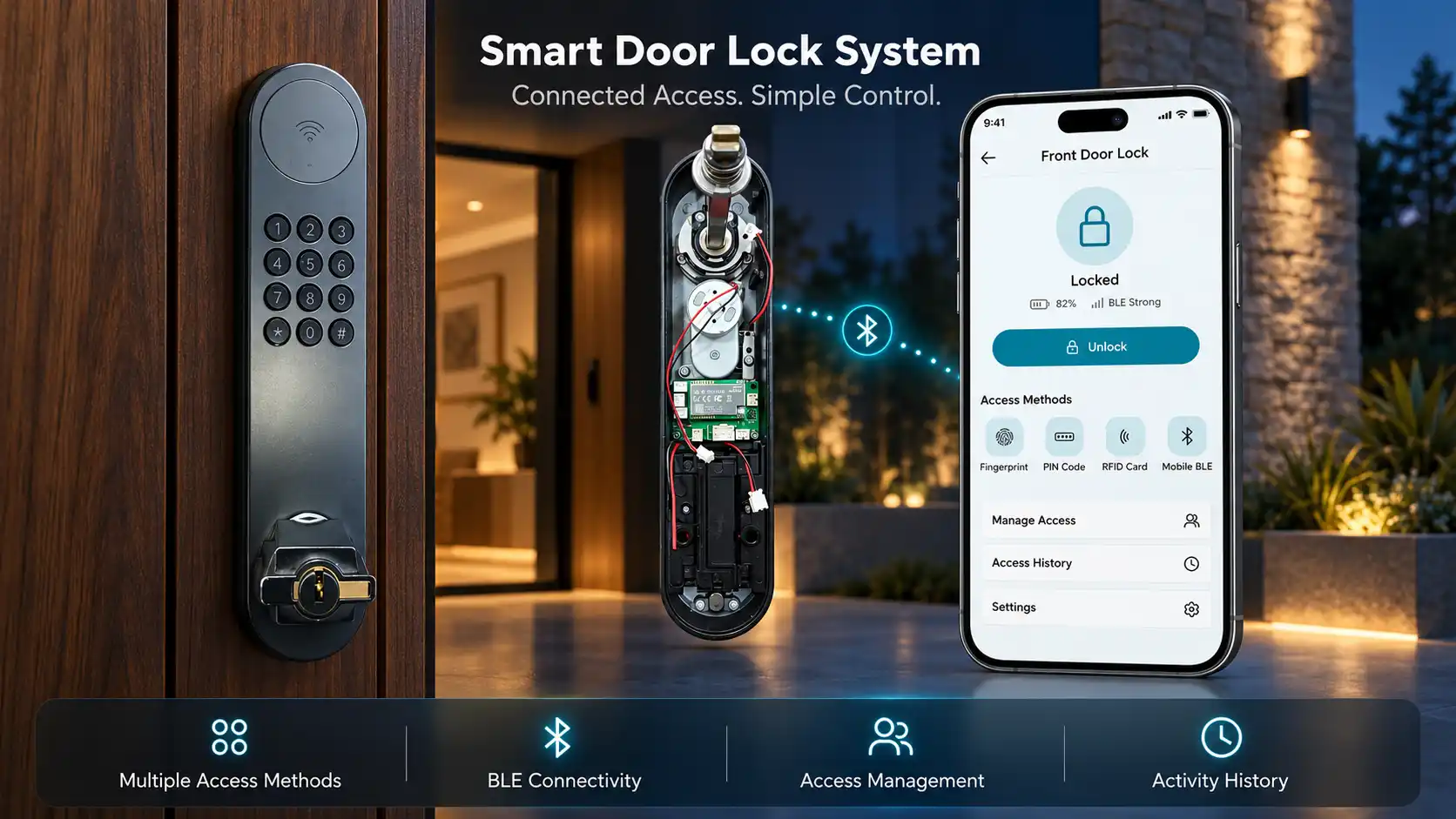
Nordic nRF52 BLE Smart Lock and Access Control
Our Nordic nRF52-powered BLE smart lock case study covers mobile, fingerprint, RFID and PIN entry, cloud management, firmware and production hardware. It demonstrates the access-control and BLE experience needed for secure distance-aware unlocking.
Read Case Study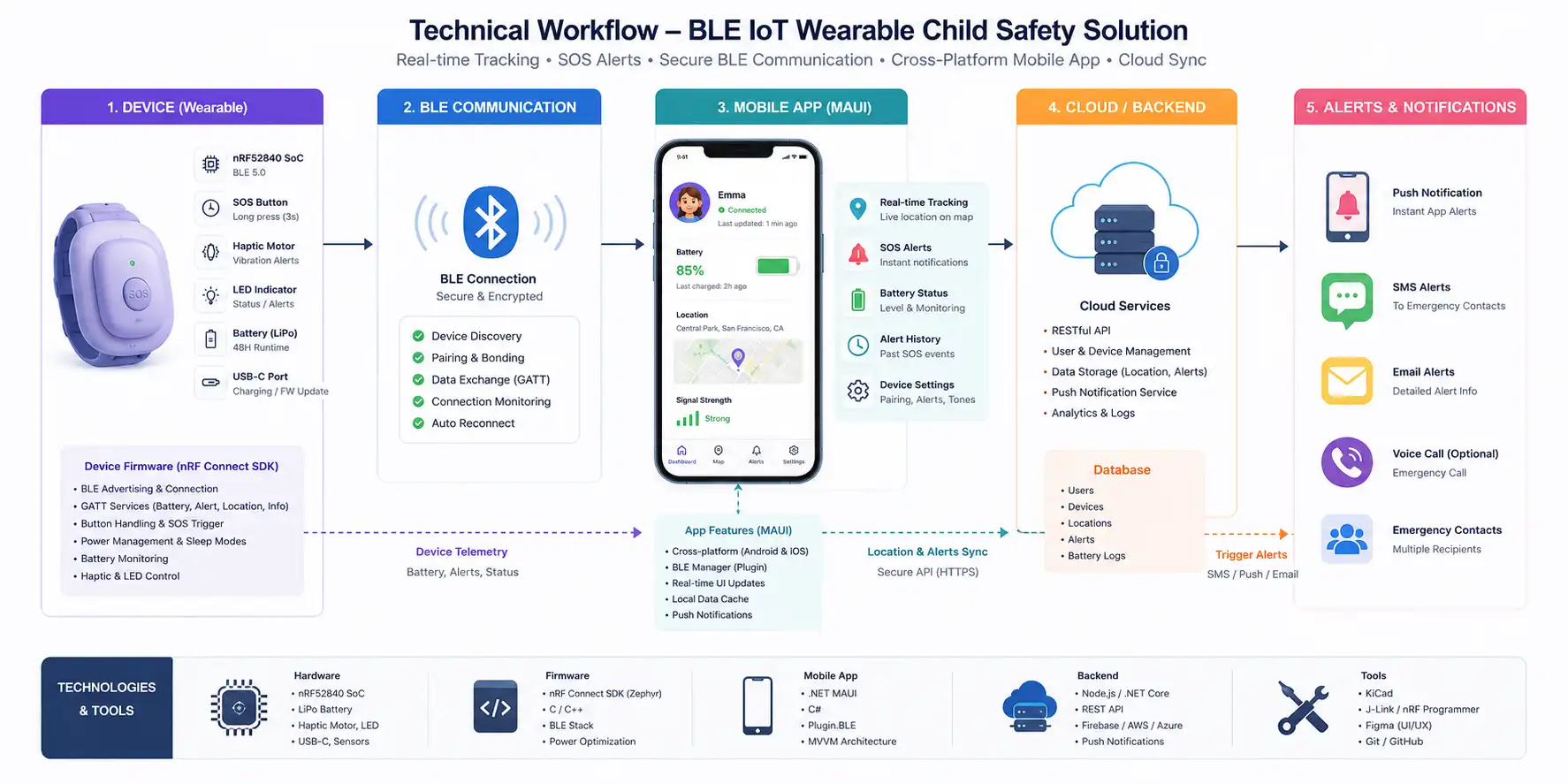
nRF52840 Wearable Child Safety Device
The wearable child safety device using nRF52840 and .NET MAUI combines custom electronics, battery-powered Nordic firmware and an app. It is relevant to compact Channel Sounding tags requiring reliable phone communication and power management.
Read Case Study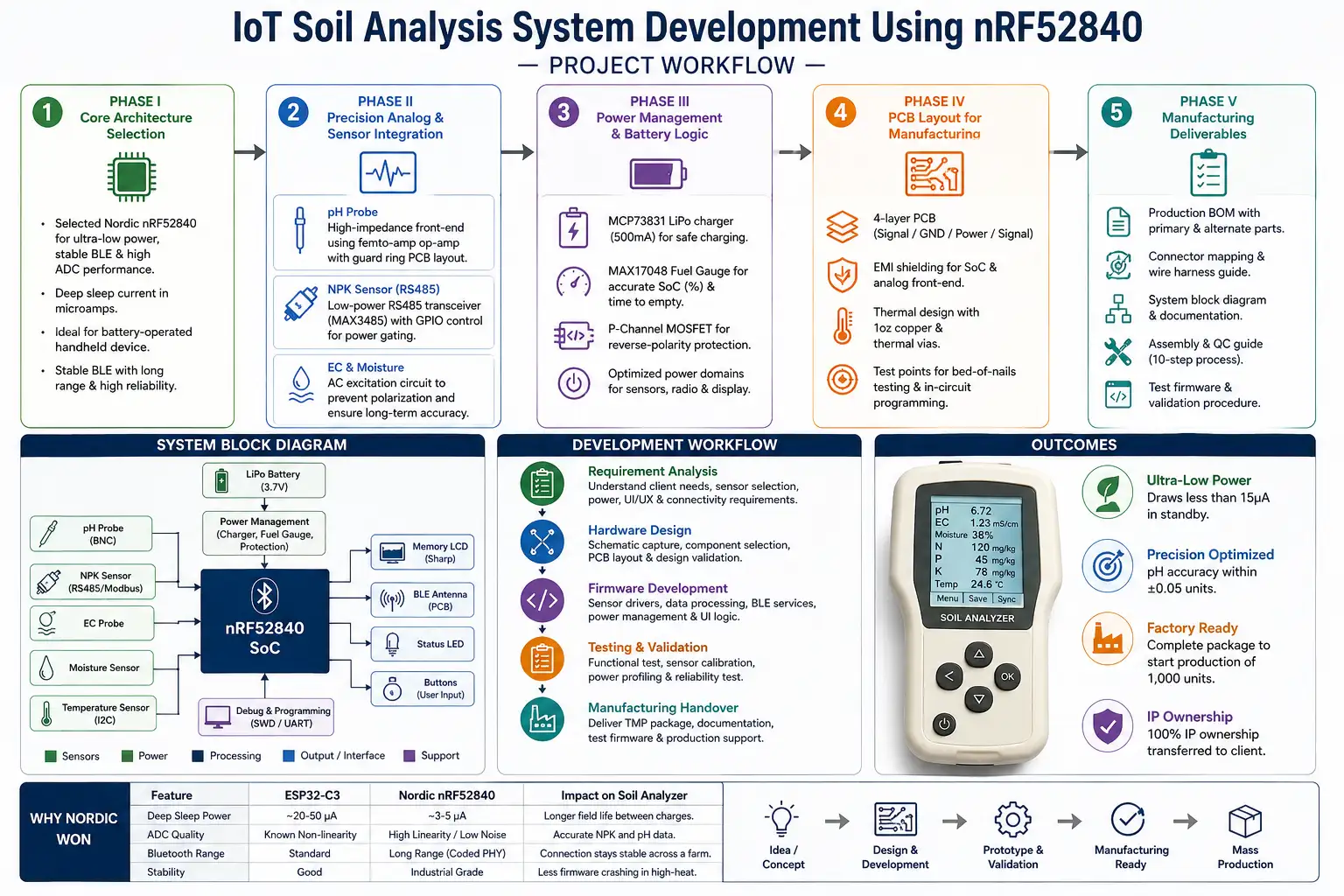
nRF52840 Soil Analysis Instrument
The IoT soil analysis system nRF52840 shows the benefits of using Nordic-based technology and implementation of embedded firmware and end-to-end portable product engineering. The same capacity monthly converges with various devices and machinery and implements any imaginable devices in portable form that can migrate to nRF54L.
Read Case StudyOur nRF54L Bluetooth Channel Sounding Development Services
Feasibility Analysis and Ranging Architecture
Initially, we present the requirements of the product and not just the required level of precision. For instance, a lock mechanism may require distinguishing between the outside and inside and avoiding any impersonation attempts.
Initially, we present the requirements of the product and not just the required level of precision. For instance, a lock mechanism may require distinguishing between the outside and inside and avoiding any impersonation attempts. In the case of a tool tracker, it may require reliable near and far zones.
An industrial controller must ensure that no unwanted activation is made before the operator reaches a safe location.
Feasibility study covers range, speed of update, latency, battery power, device roles, antennas, dependence upon phone and false acceptance and rejection limitations. We make a comparison between Channel Sounding with RSSI or Direction Finding whenever it is suitable, and create an architecture that can be tested.
nRF Connect SDK and Zephyr Firmware
We build C/C++ firmware with Nordic's nRF Connect SDK and Zephyr RTOS, including initiator and reflector configuration, secure connections, session control, measurement collection, state machines, power modes, diagnostics, recovery and firmware update.
We build C/C++ firmware with Nordic's nRF Connect SDK and Zephyr RTOS, including initiator and reflector configuration, secure connections, session control, measurement collection, state machines, power modes, diagnostics, recovery and firmware update.
A tag may use motion and coarse RSSI to avoid continuous ranging. A lock may require authentication, fresh ranging evidence and policy checks before activating. We profile memory, processor load and current on the selected SDK and hardware.
Distance Algorithm and Sensor Fusion Development
We develop or integrate algorithms that transform PBR and RTT data into distance, reject invalid samples, filter outliers and assign confidence. Channel Sounding may be fused with RSSI, IMU motion, door state or application context.
We develop or integrate algorithms that transform PBR and RTT data into distance, reject invalid samples, filter outliers and assign confidence. Channel Sounding may be fused with RSSI, IMU motion, door state or application context.
Products should not act on one noisy value. We implement hysteresis, confidence thresholds, time windows and state-aware rules, with diagnostic evidence for field investigation.
Custom PCB, RF and Antenna Design
Our hardware team handles schematics, power, sensors, antenna matching, PCB layout and design-for-manufacturing. Antenna placement, ground clearance, enclosure materials, batteries and the user's body can alter Channel Sounding observations.
Our hardware team handles schematics, power, sensors, antenna matching, PCB layout and design-for-manufacturing. Antenna placement, ground clearance, enclosure materials, batteries and the user's body can alter Channel Sounding observations.
We evaluate single- and dual-antenna designs and mechanical constraints before release. Deliverables can include design sources, Gerbers, BOM, assembly data, bring-up plans and test specifications.
Development of Secure Digital Key and Access Control Systems
Distance is just one factor for access control. In the process of delivering a control system, we take into consideration the use of pairing, authentication, verification, freshness and actuator safety together with PBR and RTT.
Distance is just one factor for access control. In the process of delivering a control system, we take into consideration the use of pairing, authentication, verification, freshness and actuator safety together with PBR and RTT. An authentication device such as a phone or fob should satisfy certain criteria in terms of zone, confidence and time window.
The models used by us allow for evaluating relay, replay, stolen devices and downgrade risks as well as devising secure booting, signed OTA, key protection, and controlled provisioning measures. Channel sounding helps reduce relay risk although it does not guarantee overall product security.
Mobile Application, Gateway and Cloud Connection
We develop native or cross-platform apps using .NET MAUI, Flutter and React Native for onboarding, identity, diagnostics, ranging status, history and updates.
We develop native or cross-platform apps using .NET MAUI, Flutter and React Native for onboarding, identity, diagnostics, ranging status, history and updates.
Applications can perform onboarding, identification, diagnostics, ranging, status monitoring, history, and updates. Additionally, if the mobile phone does not support certain functionalities, custom devices can be developed.
Cloud solutions enable the management of fleet, credential, configuration, firmware, and financial audit processes. However, personal information is kept local whenever necessary.
High-Value Channel Sounding Use Cases
Smart locks and digital keys
Verify that an authorized phone or fob is physically close before unlocking a door, vehicle, cabinet, bicycle or safe.
Find My and asset tracking
Provide finer distance feedback as a user approaches keys, luggage, tools, medical equipment or inventory.
Industrial safety
Enable machinery or HMIs only from an approved distance and add confidence to personnel/tool proximity workflows.
Smart home automation
Trigger context-aware lighting, room controls or appliance behaviour based on distance rather than unreliable RSSI alone.
Wearables and consumer devices
Locate small accessories, improve device handover or change operating modes as paired devices move closer or farther away.
Testing Accuracy, Security and Power in Real Environments
We measure previously established distances in visible paths free of hindrance, inside buildings, in places where metal is present, and in configurations worn on the body. The result is the tables of its distribution of errors, reliability, latency, and failure rate among all available data.
Testing includes the measurement of orientation, multipath propagation, noise, mobility, obstacles, battery condition, and the presence of Bluetooth signals concurrently. Security tests deal with replay, relaying, freshness, incorrect identification, and a rollback property.
Development Process and Deliverables
We progress through discovery, proof of concept, algorithm evaluation, hardware, firmware, app integration, bring-up, calibration, verification and manufacturing handover. Early prototypes must meet decision thresholds in representative environments before production tooling.
Deliverables can include architecture, source code, PCB files, ranging datasets, calibration, test reports, threat model, app, APIs and production instructions. Traceability supports future SDK and hardware revisions.
Frequently Asked Questions
No. RSSI uses the received signal strength to determine location but can easily be affected by obstructions and other variables. Channel Sounding uses a variety of frequencies and other data to determine location more accurately.
Usually not. Channel Sounding introduces new controller and physical-layer capabilities, so an older product may require a compatible SoC such as an nRF54L device and corresponding hardware and firmware changes. We audit the existing design and create a migration plan.
No. Nothing can be guaranteed unless tested in real life. Bluetooth has been designed with centimeter accuracy in mind but various factors come into play in the process of using it.
Editorial Sources