















 Mean Stack Development
 Vue JS Development
 Javascript Development
 React JS Development
 Angular JS Development
 Next JS development
 Java Development
 Python Development
 Django Development
 Cherrypy Development
 C# Development
 ASP.NET Development
 NodeJS Development
 Laravel Development
 CodeIgniter Development
 Zend Development
 Ruby on Rails Development
 CakePHP Development
 PHP Website Development
 Symfony Development
 Drupal Development
 Joomla Development
 Wordpress Development
 .NET Nuke Development
 Kentico
 Umbraco
 .NET MAUI Development
 Xamarin Application Development
 iOS Application Development
 Android Application Development
 Android Wear App Development
 Ionic Development
 iBeacon Application Development
 Universal Windows Platform (UWP)
 Kotlin Application Development
 Swift Application Development
 Flutter Application Development
 PWA Application Development
 Flutter Health Tech & Wearable App Development Company
 React Native Health Tech Wearable App Development
 Offshore Software Development
 Custom Application Development
 Front-End Development
 Full Stack Development
 AI & Machine Learning
 Custom CRM Solutions
 Flask Software Development
 Electron JS Development
 ChatGPT Development
 Telemedicine App Development
 Build Smart Telemedicine Platform
 Beauty & Salon App Solutions
 Hire Workato Experts
 Magento Development
 Magento 2.0 Development
 Magento Enterprise
 Shopping Cart Development
 Prestashop Development
 Shopify Development
 Open Cart Development
 WooCommerce Development
 BigCommerce Development
 NopCommerce Development
 Virto Commerce Development
 AspDotNetStorefront Development
 .NET Application Development
 Microsoft Dynamics CRM
 VB .NET Development
 Sharepoint Migration
 ASP.NET Core Development
 ASP.NET MVC Development
 AJAX Development
 Agile Development
 Microsoft Bot
 Microsoft Blazor
 Microsoft Azure Cognitive
 HTML 5
 UI/UX Design
 Graphic Design
 Adobe Photoshop
 XML Application Development
 Cloud Computing Solutions
 Azure Cloud App Development
 AWS Development
 Google Cloud Development
 Certified AWS IoT Services Developers
 DevOps Consulting & Development
 Kubernetes Consulting & Services
 SQL Programming Development
 MySQL Development
 MongoDB Development
 Big Data
 Robotic Process Automation
 Social Media Marketing
 Search Engine Optimization
 QA Testing
 Software Testing
 Software Security
 Maintenance And Support
 I.T. Consulting Services
 Business Intelligence
 YII Development
 Data Analysis
 Alexa Skills Development
 On Demand App for Mobile repairing services
 On Demand App for Car Service Booking
 On Demand App for Cleaning Services
 On Demand App for Pharmacy
 On Demand Dedicated Developers
 On Demand Lawyer App Development









 Nuki Smart Lock
 Salto Smart Lock
 TTlock Smart Lock
 NFC App Development
 Custom IOT Enabled Smart Lock
 Smart Locker Solutions
 Hospital Smart Lock Systems
 Hotel Smart Lock Systems
 Smart Home & Office Locks
 Smart Access for Schools & Colleges
 Unloc Smart Lock Integration
 Yale & August Smart Lock Integration
 Populife Smart Lock Integration
 Smart Lock Hardware Development
 Dairy IoT Solutions
 Agri IoT & AI Solutions
 Weather & Climate Solutions
 Water & Waste Management Solutions
 RaspBerry Pi
 Firmware Software Development
 ESP 32 Software Development
 Embedded Development
 Internet of Things
 Smart IoT Development
 IoT Sensor Integration & Development Solutions
 Smart IoT System Development for HVAC
 Tuya IoT App Development
 Particle IoT SDK
 IoT Development with AI
 Smart Pet GPS Tracker
 Dairy GPS Tracking Solutions
 GPS Fleet Management Software
 Car Rental & Subscription Solutions
 Car Buy & Sell Marketplace Development
 AI-Powered Car Wash App Development
 PCB Design & Fabrication
 IoT AC Automation
 AI–IoT Painting Solutions
 IoT Wearable Hardware & App Development
 HVAC Automation & AI Control Systems
 Smart Home IoT Engineering
 AI Embedded Systems
 AI Hardware Design Service
 Advanced IoT Hardware & Firmware Development
 Device Driver Development Services
 NXP i.MX RT Firmware & Hardware Services
 Microchip PIC & AVR Development
 Hire IoT Architects
 IoT Cloud & Infrastructure Solutions
 Infineon XMC / AURIX Development Services
 Matter & Thread IoT Services
 Native IoT Mobile App Development (BLE & Wi-Fi)
 Snapdragon IoT Firmware Development
 Renesas RA/RX Firmware Services
 Silicon Labs EFR32 Development Services
 Smart Wearable App Development
 Smart IoT Meters
 Smart Healthcare Wearable App Development
 Health Care Monitoring System
 Fitness Tracking App Development
 Smart Home Automation Apps
 nRF PCB Design
 ESP32 PCB Design
 Embedded Wearables Engineers
 Rental Property Management System
 Building Management System
 Smart Lighting Development
 Infineon Semiconductor Firmware Development Services
 Custom Camera Development: Hardware, Firmware & PCB Prototyping
 Smart Security Camera SDK
 Nordic Semiconductor SDK
 Infineon SDK
 Arduino SDK
 NFC Lock Integration
 Kerong Lock Integration
 IoT & AI Solutions for Manufacturing
 Smart Inventory & Logistics Solution
 Food & Beverage Industry Solutions
 Smart Hospitality Solutions
 Smart Property Management
 Custom Smart Home IOT SDK
 Smart IoT & AI in Healthcare
 AI-Powered Security Solutions
 Smart Home Safety & AI
 Veterinary Clinic Management (AI)
 Pet Care System (AI & IoT)
 Pet Training & Adoption (AI)
 Healthcare IoT Development
 Event Management Software
 Money Remittance App
 Money Lending App Development
 Utility and Bill Payment App
 IoT Mobile App Development (Flutter & React Native)
 AI & IoT Retail Solutions
 Smart EV App Development
 Smart Solar IoT & AI Solutions
 IoT-Based Energy Systems
 Smart Energy & Utilities Solutions
 6G Solutions
 IoT Security Solutions
 AI-Powered Lottery App Development
 AI-Sports Fitness Club Management
 Travel
 Real Estate
 Medical & Healthcare
 e-Learning
 Consumer Products
 Finance
 Automobile
 Media & Entertainment
 Billing Software
 Enterprise Resource Planning (ERP)
 Augumented & Virtual Reality
 Point of Sale(POS) Development
 Learning Management System
 EV Charging Solutions
 About Us
 Partners & Certifications
 Quality Assurance
 Our Clients & Testimonials
 Development Process
 Our Products
 Social Responsibility
 Work Ethics
 Vision & Mission
 Awards
 Live Project Demos
 Contact Us
 Case Studies
 Portfolio
 Blog
Blog
Ambiq Apollo510B Worker Safety Badge Development Services | Fall Detection & BLE Alerts
A worker-safety badge is not valuable because it collects motion data. It is valuable when it detects a potentially serious event, communicates the right information quickly and fits into a clearly defined response process.
Adequate Infosoft develops custom connected safety badges using platforms such as Ambiq Apollo510B for construction, warehousing, manufacturing, utilities, logistics and lone-worker programmes.
All sensor-fusion firmware, event-detection logic, Bluetooth Low Energy connectivity, mobile or gateway integration, back-end alert workflows and battery-life validation becomes a part of a single practical process of product engineering.
Apollo510B offers a high-performance Arm Cortex-M55 processor with Helium vector capabilities, integrated Bluetooth Low Energy 5.4 features, low-power memory and device-security functions.
That capability is useful in a compact badge where accelerometer data must be processed locally, alerts need to be sent efficiently and the device must operate for extended periods without frequent charging.
A connected badge should always enhance, not substitute, site risk assessments, trained supervisors, emergency procedures, personal protective equipment (PPE) and fall protection measures that are required by the law.
The purpose of the product is to enhance awareness and reduce the time taken to ascertain an incident and activate a human response.
Let's Work Together!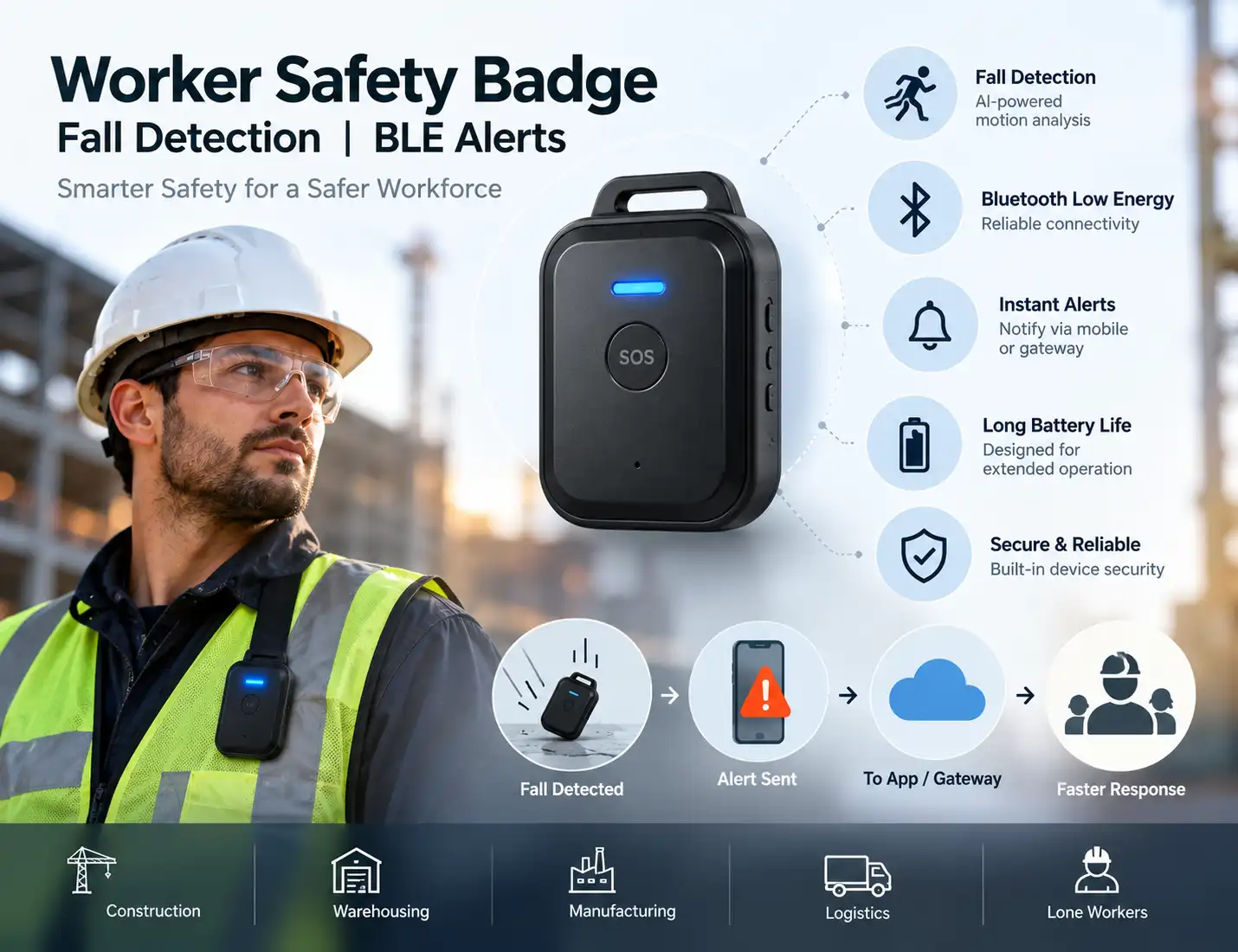
Case Study: Connected Safety Badge for Fall Events and Escalation Alerts
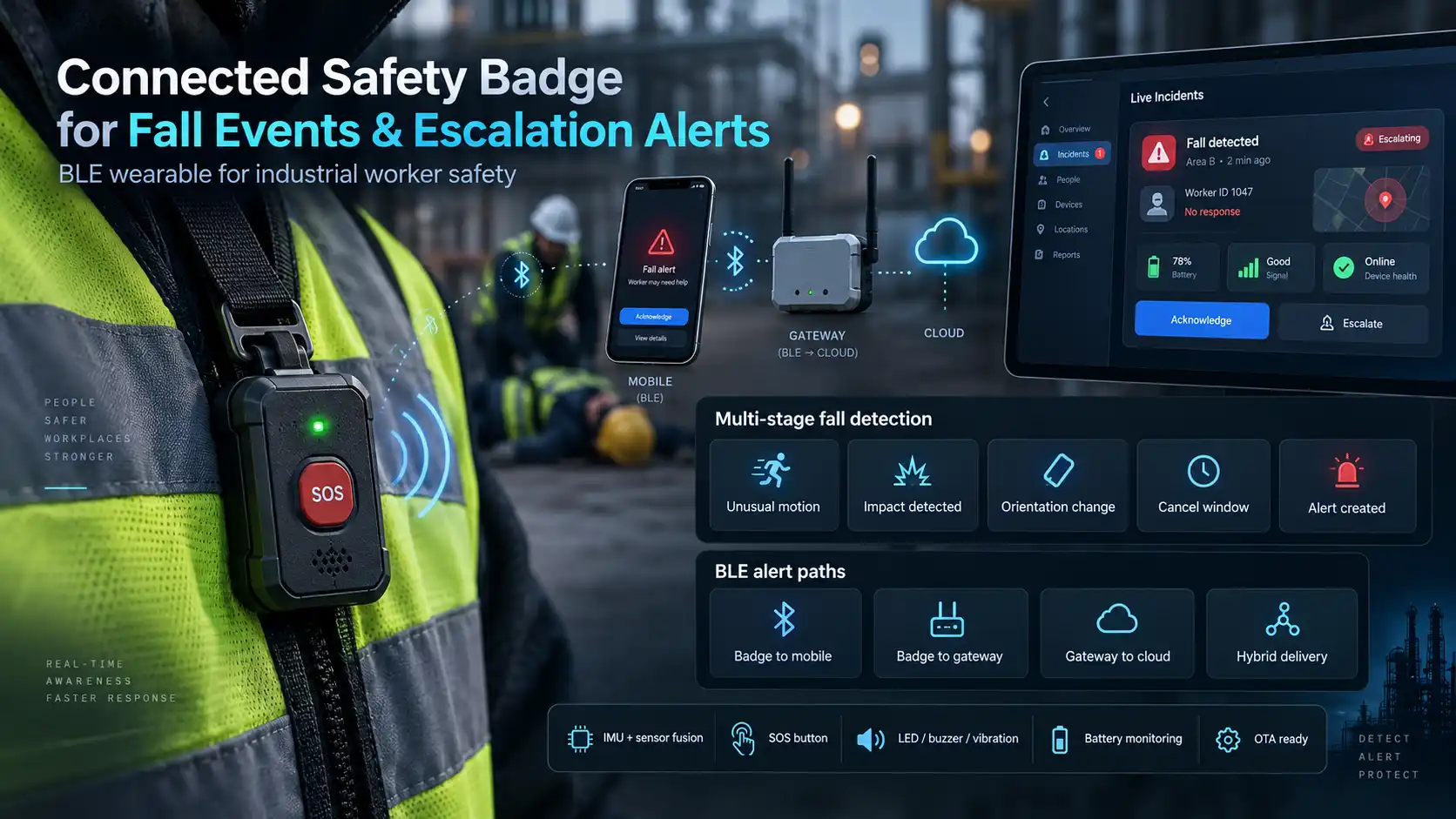
This case study describes a worker-safety badge designed for teams operating in industrial and field environments.
The badge could be clipped to the clothing of a person or attached to a lanyard or a protective piece of equipment.
The badge in question can monitor motion patterns that are indicative of a fall or allow a worker to ask for assistance. In this way, the badge can also send alerts either with help of a mobile device or BLE gateway nearby.
The product scope included:
An IMU measuring acceleration and orientation with either 3 axis or 6 axes. Local sensor fusion and fall event assessment. Support for the SOS button. Vibration, LED entity, or sound feedback for the worker. Communication through BLE technology with phone, hub, etc. Record of incidents along with the health status of the device. Option for setting up alerts in escalation workflows. Battery monitoring and low battery indication. Safe provisioning and planning for firmware updates. A web or mobile user interface for supervisors with access rights only.
The main design question was simple but important: how can the badge detect a possible fall without creating an unmanageable number of false alarms?
An actual fall may consist of quick downward speeds, a crash, an immediate change of direction, and a moment of minimal movement.
However, similar patterns of the sensor may also be observed if the worker puts down the tool bag, jumps from a low step, drops the badge, has a sudden movement in the chair or rides over rough terrain.
This is why the badge was made with a multi-stage detection system instead of one-acceleration signal solution. The firmware analyzed series of evidence:
Free-Fall or Unusual Acceleration Event
The IMU has identified a brief time that indicates a fall, quick movement, or irregular acceleration.
Shock or High-Energy Change
The next peak in acceleration is compared against the preset thresholds.
Post-Event Orientation and Inactivity
The badge looks if there has been any significant change in position and whether movement has been low throughout the confirmation time interval.
Worker Cancellation Possibility
Should the user be able to react, the badge is able to send vibration, sound, or light warning signals, and cancel the detected event.
Alert Creation and Acknowledgement
If the event remains unconfirmed or has not been canceled, the device creates alert logs and starts the configured delivery process.
This rationale minimizes the chances of perceiving every sudden motion as an alarming strike. In addition, it facilitates transparent operation: a dashboard may indicate whether the alarm was triggered manually, automatically, cancelled by the employee, transmitted to the gateway, or acknowledged by the supervisor.
Thresholds are unique and do not hold true for everyone. For instance, a warehouse worker, a field technician, a worker working at a height and a worker being transported will exhibit different motion patterns.
A competent company designs firmware with adjustable detecting parameters and prepares field-testing plans involving representative roles, locations of the devices and activities.
The firmware of the Apollo510B badge was structured in a way that it included low-power services, which were able to run alone and recover secure from errors. The IMU, however, operated with interrupt-based sampling whenever necessary, which made it possible for the processor to be in low power state up to the moment the values of interest were obtained.
Sensor fusion combined accelerometer and gyroscope information to estimate motion intensity, orientation transition and stationary conditions. The algorithm maintained short rolling windows instead of storing every sample indefinitely.
It then calculated features such as acceleration magnitude, impact duration, orientation difference, motion variance and post-event inactivity.
The event under consideration received a confidence score. An instance of object movement with no further action taken could be flagged as an incident, but no emergency notification would be sent. The manual pressing of the SOS button may be prioritized and trigger the alerting process. This system will not allow assessment of safety based on a single sensor reading.
The firmware takes into account various conditions of the device. For example, in case the badge indicates critically low battery, a broken IMU, incorrect configuration or repeated resetting, the problem must be communicated.
Failing to do this will put the responsible personnel at risk as they will believe the worker is safe while the device is not operational.
Typical embedded modules included:
IMU driver and sensor self-test Event-driven sampling and timestamp management Sensor-fusion and orientation processing Fall-candidate and manual-SOS state machines Haptic, buzzer and LED controller BLE advertising, connection and alert-transfer services Local event storage with synchronization status Battery measurement and power-mode controller Configuration, diagnostics and watchdog recovery Secure bootloader and OTA-update readiness
Bluetooth Low Energy is an effective option for a badge because it supports small, power-conscious messages to a nearby phone, fixed gateway or site hub. However, BLE range and reliability depend on building construction, metal machinery, people, device placement, interference and gateway coverage. A worker-safety system must plan for those conditions rather than assume a single published range figure.
The badge can use one of several alert paths:
Badge to Mobile Device
This option works best for a user who is using a controlled Android or iOS device.
Badge to Fixed Gateway
This option can be used in a workplace that is prepared for installation of gateways.
Badge to Gateway and Cloud
This allows managers to monitor an incident.
Hybrid Delivery
The badge will notify about urgent incidents until either a controlled device or gateway confirms receipt.
The alert's payload may consist of badge ID, event type, timestamp, confidence degree, battery condition, and the last known zone or gateway location.
When there is RTTLS in the architecture, the location should be displayed with its actual precision level and confidence degree, instead of giving it false claims of accurate GPS positioning.
To be delivered successfully, the delivery must be confirmed. The badge has to log if the alert was generated locally or received by the gateway or acknowledged by the cloud API, and read by the responder.
If a first path fails, the workflow may retry for a defined period or use an available fallback path. These decisions should be agreed with the site's safety team because network retries cannot replace an emergency response plan.
The backend workflow was centered on individuals instead of notifications alone. The fall event detected could initiate an incident card on a supervisor's dashboard, send alerts to designated responders, depict the device and the worker-related information, and keep a record of efforts and responses over time.
A typical workflow could be:
Badge detects a possible fall. Badge provides a short cancellation window. If not cancelled, the badge transmits the incident through BLE. Gateway or mobile app forwards the event to a secure API. The platform creates an incident and alerts the assigned safety group. A responder acknowledges the event and attempts contact. The system records the response actions for later review.
The system can be adjusted according to site, time of day, worker category and escalation procedures. For example, the night team may need a different list of responders than the warehouse team does during the day.
Audit information is important for ongoing development work, but access to worker data must be controlled by titles and preserved as per company regulations.
Worker badges require realistic testing of batteries. A gadget that can survive for weeks on a desk can act very differently in real-life conditions such as a lot of movement, Bluetooth Low Energy (BLE) retransmissions, temperature variations, or alert notifications.
We create a current budget model for all activities performed during sleep, sensing, BLE broadcasting, connection events, alert transmission, vibration, buzzer operation, and LED function and validate it on representative hardware.
The test plan can include:
Normal shift operation High-motion and vehicle-motion scenarios Gateway coverage gaps and reconnection attempts Repeated manual SOS events Long inactivity periods Low-battery notifications Temperature and charging tests Drop and enclosure-use testing Firmware reset and recovery behaviour
The goal is an evidence-based battery-life target and a defined operational policy for charging, battery replacement and low-battery escalation.
Our Apollo510B Worker-Safety Badge Development Services
Adequate Infosoft provides embedded, mobile, cloud and IoT engineering services for connected worker-safety devices, lone-worker badges, wearable alert buttons, industrial monitoring products and BLE gateway ecosystems.
Development of Sensor Fusion and Fall Detection
We work to integrate IMU, to create motion processing systems, fall event state machines, orientation analysis systems, manual SOS processes and user-defined alert thresholds.
We work to integrate IMU, to create motion processing systems, fall event state machines, orientation analysis systems, manual SOS processes and user-defined alert thresholds.
We facilitate the gathering of field data and conduct test reviewing so that the detection of an event derives from real workplace activity instead of artificial lab activities.
Wireless Firmware and BLE Gateway Integration
Our team builds BLE advertising, GATT services, secure pairing, gateway communication, background synchronization and retry logic.
Our team builds BLE advertising, GATT services, secure pairing, gateway communication, background synchronization and retry logic.
We can integrate the badge with Android or iOS applications, dedicated Linux gateways, cloud ingestion services and supervisor dashboards. The design includes delivery acknowledgements and offline handling, which are essential in real industrial environments.
Creation of Custom Alert Platforms and Dashboards
We provide custom API development services based on ASP.NET Core, PostgreSQL data modeling, React or Angular dashboards, role-based access control, notification services and incident viewer applications.
We provide custom API development services based on ASP.NET Core, PostgreSQL data modeling, React or Angular dashboards, role-based access control, notification services and incident viewer applications.
The platform may provide an access to the employees, managers, administrators and emergency responders with separate permissions and audit perspectives.
Device Security, OTA and Fleet Management
We help teams plan secure provisioning, signed firmware updates, device identity, configuration control and fleet diagnostics.
We help teams plan secure provisioning, signed firmware updates, device identity, configuration control and fleet diagnostics.
Apollo510B security features can form part of the device trust model; the wider solution also needs controlled backend APIs, key-management processes and tested update rollback procedures.
Hardware, Energy, and Production Support
We provide services including development of wearable PCB designs, selecting the right battery and other components, designing enclosures and attaching them to the PCB, testing firmware, carrying out power profile tests, giving advice on EVT and DVT phases, and preparing technical documents.
We provide services including development of wearable PCB designs, selecting the right battery and other components, designing enclosures and attaching them to the PCB, testing firmware, carrying out power profile tests, giving advice on EVT and DVT phases, and preparing technical documents.
We assist in transforming a prototype badge into a product that can be provided across different locations.
Relevant Adequate Infosoft IoT Experience
Adequate Infosoft has developed connected smart-lock and access-control solutions involving BLE devices, mobile applications, cloud APIs, gateway communication, user permissions, notifications and device-status workflows.
This experience is directly relevant to worker-safety badges because both product types depend on reliable event processing, secure user/device relationships and predictable behaviour when connectivity is intermittent.
The ESP32-S3 Adhesive PVDF Biosensor Prototype is also an addition to our wearable portfolio. It features various properties that include, but not limited to, flexible sensing materials, analogue signal conditioning, a 24-bit ADC, embedded processing, and BLE.
The fall-detection badge deploys a different sensing model than that of the biosensor, but the engineering principles match and what is needed is to validate the signal path, implement energy-saving solutions, log real device status, and avoid overpromising the capabilities of the device.
A custom Apollo510B worker-safety badge can provide a valuable additional layer of visibility when it is engineered as part of a complete safety workflow.
Adequate Infosoft helps organisations build that workflow from embedded event detection through secure alerts, dashboards and long-term device support.
Editorial Resources