















 Mean Stack Development
 Vue JS Development
 Javascript Development
 React JS Development
 Angular JS Development
 Next JS development
 Java Development
 Python Development
 Django Development
 Cherrypy Development
 C# Development
 ASP.NET Development
 NodeJS Development
 Laravel Development
 CodeIgniter Development
 Zend Development
 Ruby on Rails Development
 CakePHP Development
 PHP Website Development
 Symfony Development
 Drupal Development
 Joomla Development
 Wordpress Development
 .NET Nuke Development
 Kentico
 Umbraco
 .NET MAUI Development
 Xamarin Application Development
 iOS Application Development
 Android Application Development
 Android Wear App Development
 Ionic Development
 iBeacon Application Development
 Universal Windows Platform (UWP)
 Kotlin Application Development
 Swift Application Development
 Flutter Application Development
 PWA Application Development
 Flutter Health Tech & Wearable App Development Company
 React Native Health Tech Wearable App Development
 Offshore Software Development
 Custom Application Development
 Front-End Development
 Full Stack Development
 AI & Machine Learning
 Custom CRM Solutions
 Flask Software Development
 Electron JS Development
 ChatGPT Development
 Telemedicine App Development
 Build Smart Telemedicine Platform
 Beauty & Salon App Solutions
 Hire Workato Experts
 Magento Development
 Magento 2.0 Development
 Magento Enterprise
 Shopping Cart Development
 Prestashop Development
 Shopify Development
 Open Cart Development
 WooCommerce Development
 BigCommerce Development
 NopCommerce Development
 Virto Commerce Development
 AspDotNetStorefront Development
 .NET Application Development
 Microsoft Dynamics CRM
 VB .NET Development
 Sharepoint Migration
 ASP.NET Core Development
 ASP.NET MVC Development
 AJAX Development
 Agile Development
 Microsoft Bot
 Microsoft Blazor
 Microsoft Azure Cognitive
 HTML 5
 UI/UX Design
 Graphic Design
 Adobe Photoshop
 XML Application Development
 Cloud Computing Solutions
 Azure Cloud App Development
 AWS Development
 Google Cloud Development
 Certified AWS IoT Services Developers
 DevOps Consulting & Development
 Kubernetes Consulting & Services
 SQL Programming Development
 MySQL Development
 MongoDB Development
 Big Data
 Robotic Process Automation
 Social Media Marketing
 Search Engine Optimization
 QA Testing
 Software Testing
 Software Security
 Maintenance And Support
 I.T. Consulting Services
 Business Intelligence
 YII Development
 Data Analysis
 Alexa Skills Development
 On Demand App for Mobile repairing services
 On Demand App for Car Service Booking
 On Demand App for Cleaning Services
 On Demand App for Pharmacy
 On Demand Dedicated Developers
 On Demand Lawyer App Development










 Nuki Smart Lock
 Salto Smart Lock
 TTlock Smart Lock
 NFC App Development
 Custom IOT Enabled Smart Lock
 Smart Locker Solutions
 Hospital Smart Lock Systems
 Hotel Smart Lock Systems
 Smart Home & Office Locks
 Smart Access for Schools & Colleges
 Unloc Smart Lock Integration
 Yale & August Smart Lock Integration
 Populife Smart Lock Integration
 Smart Lock Hardware Development
 Dairy IoT Solutions
 Agri IoT & AI Solutions
 Weather & Climate Solutions
 Water & Waste Management Solutions
 RaspBerry Pi
 Firmware Software Development
 ESP 32 Software Development
 Embedded Development
 Internet of Things
 Smart IoT Development
 IoT Sensor Integration & Development Solutions
 Smart IoT System Development for HVAC
 Tuya IoT App Development
 Particle IoT SDK
 IoT Development with AI
 Smart Pet GPS Tracker
 Dairy GPS Tracking Solutions
 GPS Fleet Management Software
 Car Rental & Subscription Solutions
 Car Buy & Sell Marketplace Development
 AI-Powered Car Wash App Development
 PCB Design & Fabrication
 IoT AC Automation
 AI–IoT Painting Solutions
 IoT Wearable Hardware & App Development
 HVAC Automation & AI Control Systems
 Smart Home IoT Engineering
 AI Embedded Systems
 AI Hardware Design Service
 Advanced IoT Hardware & Firmware Development
 Device Driver Development Services
 NXP i.MX RT Firmware & Hardware Services
 Microchip PIC & AVR Development
 Hire IoT Architects
 IoT Cloud & Infrastructure Solutions
 Infineon XMC / AURIX Development Services
 Matter & Thread IoT Services
 Native IoT Mobile App Development (BLE & Wi-Fi)
 Snapdragon IoT Firmware Development
 Renesas RA/RX Firmware Services
 Silicon Labs EFR32 Development Services
 Smart Wearable App Development
 Smart IoT Meters
 Smart Healthcare Wearable App Development
 Health Care Monitoring System
 Fitness Tracking App Development
 Smart Home Automation Apps
 nRF PCB Design
 ESP32 PCB Design
 Embedded Wearables Engineers
 Rental Property Management System
 Building Management System
 Smart Lighting Development
 Infineon Semiconductor Firmware Development Services
 Custom Camera Development: Hardware, Firmware & PCB Prototyping
 Smart Security Camera SDK
 Nordic Semiconductor SDK
 Infineon SDK
 Arduino SDK
 NFC Lock Integration
 Kerong Lock Integration
 IoT & AI Solutions for Manufacturing
 Smart Inventory & Logistics Solution
 Food & Beverage Industry Solutions
 Smart Hospitality Solutions
 Smart Property Management
 Custom Smart Home IOT SDK
 Smart IoT & AI in Healthcare
 AI-Powered Security Solutions
 Smart Home Safety & AI
 Veterinary Clinic Management (AI)
 Pet Care System (AI & IoT)
 Pet Training & Adoption (AI)
 Healthcare IoT Development
 Event Management Software
 Money Remittance App
 Money Lending App Development
 Utility and Bill Payment App
 IoT Mobile App Development (Flutter & React Native)
 AI & IoT Retail Solutions
 Smart EV App Development
 Smart Solar IoT & AI Solutions
 IoT-Based Energy Systems
 Smart Energy & Utilities Solutions
 6G Solutions
 IoT Security Solutions
 AI-Powered Lottery App Development
 AI-Sports Fitness Club Management
 Travel
 Real Estate
 Medical & Healthcare
 e-Learning
 Consumer Products
 Finance
 Automobile
 Media & Entertainment
 Billing Software
 Enterprise Resource Planning (ERP)
 Augumented & Virtual Reality
 Point of Sale(POS) Development
 Learning Management System
 EV Charging Solutions
 About Us
 Partners & Certifications
 Quality Assurance
 Our Clients & Testimonials
 Development Process
 Our Products
 Social Responsibility
 Work Ethics
 Vision & Mission
 Awards
 Live Project Demos
 Contact Us
 Case Studies
 Portfolio
 Blog
Blog
Ambiq Apollo4 Blue Smart Home Sensor with Multi-Year Battery Design
Adequate Infosoft develops low-power smart-home products using the Ambiq Apollo4 Blue platform.
Our work covers electronics, embedded firmware, Bluetooth Low Energy (BLE), sensor integration, mobile and cloud connectivity, power measurement, prototype validation, and production engineering.
Apollo4 Blue is designed for connected products with energy awareness built in, which, in turn, need an Arm-based microcontroller, Bluetooth Low Energy connectivity, sensor interfaces, and various low-power states for proper operation.
However, just using a low-power microcontroller does not mean the product will necessarily achieve multi-year battery life.
Battery life is achieved at system level, which includes the firmware architecture, sensing schedule, radio parameters, wake-up methods, sensor current draw, regulator performance, battery type, PCB leakage, user habits, and actual environmental conditions.
This case study explains how an Apollo4 Blue smart-home sensor can be designed around measurable power budgets rather than assumptions.
Let's Work Together!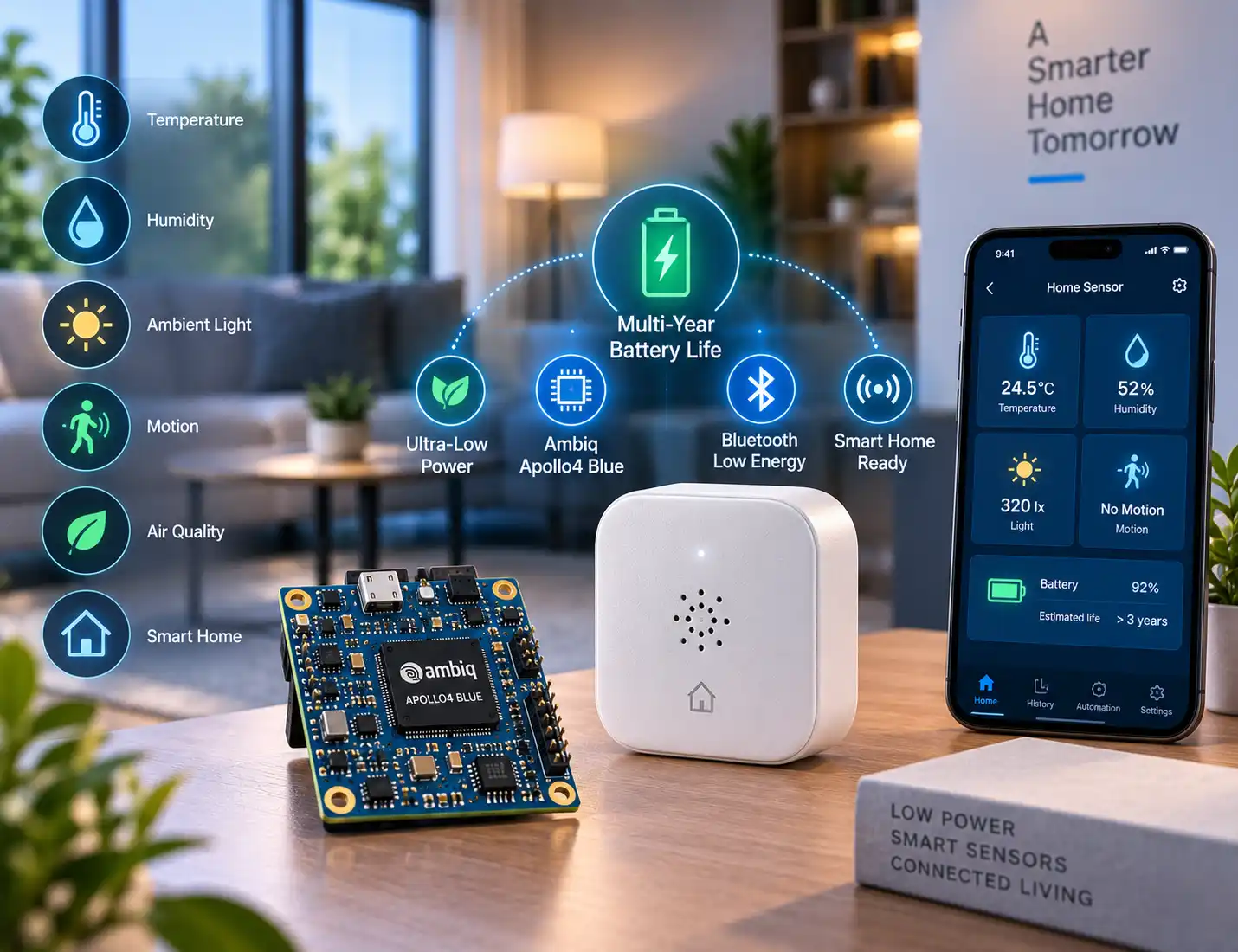
Product Goal: A Sensor Designed to Sleep Most of the Time
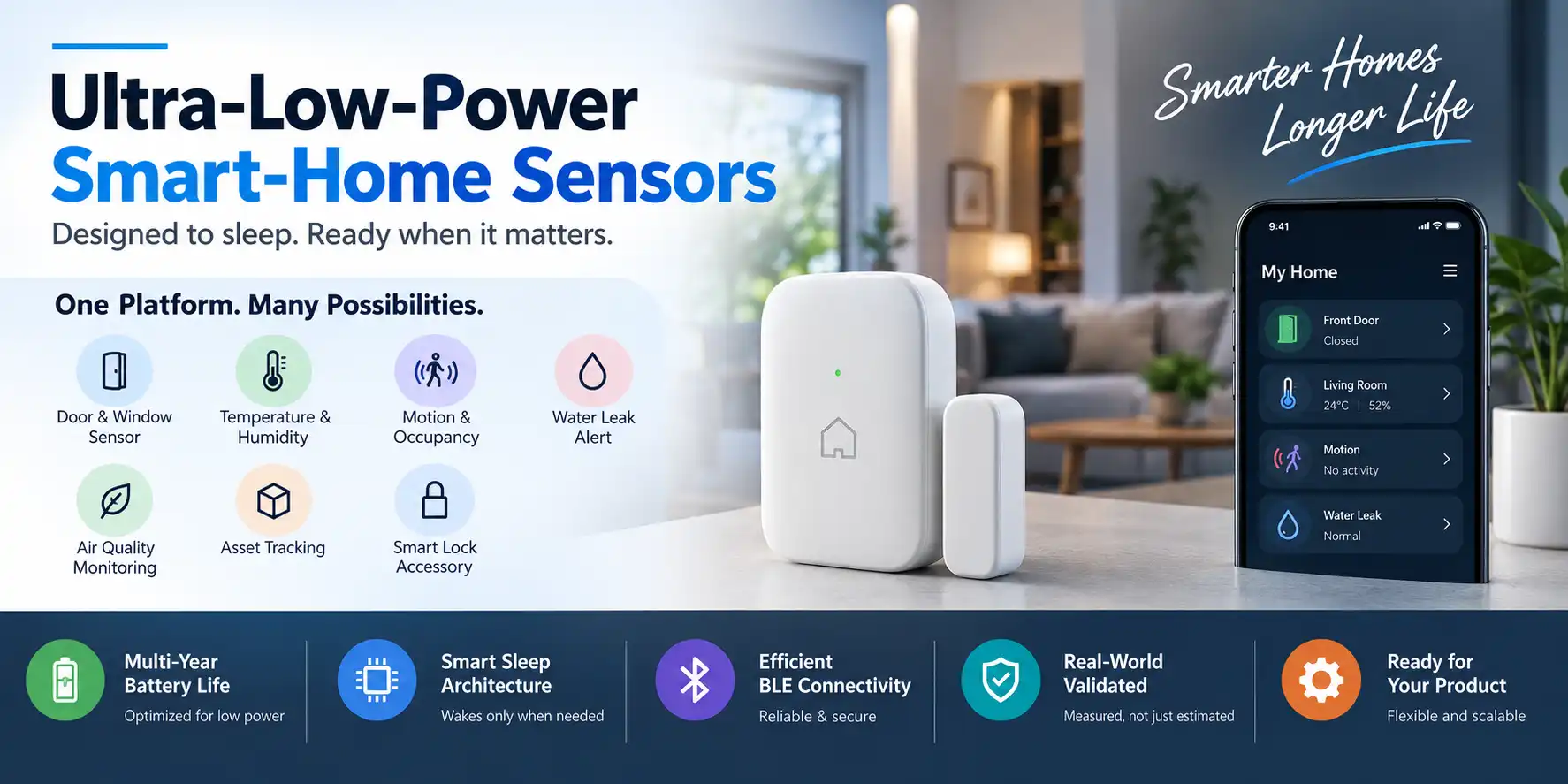
The desired outcome was a small wireless smart-home sensor system designed for long-term operation on batteries. The system could be modified for different products, such as:
Door, window, drawer, or cabinet contact sensor Room temperature and humidity sensor Motion, occupancy, or light-level sensor Water-leak and freeze-alert device Indoor air-quality or comfort-monitoring sensor Battery-powered asset or equipment-status node Smart-lock accessory or access-event sensor
The central engineering question was simple: how can the device deliver useful data and responsive alerts while spending as little time as possible in an active state?
A practical answer begins with the duty cycle. The sensor is not designed to run continuously. It remains in the lowest suitable sleep state for the majority of its life, wakes from a scheduled timer or interrupt, performs a short task, sends data only when needed, and immediately returns to sleep.
For instance, a heat sensor might wake up every 10 or 15 minutes, activate the sensing device, get a stable measurement, check it against the last known measurement and the preset thresholds, and transmit some data only when an important change is detected.
In the same way, a door sensor can be keep sleeping until a reed switch or Hall sensor generates some interrupt. A water leakage sensor will be checking the battery level regularly while at the same time focusing on transmitting the information after the leak has been discovered.
This event-driven design avoids treating every sensor as a continuously connected device.
Before hardware or firmware development, our engineers define a battery model based on the product's intended use. We identify every operating mode and estimate its current consumption and duration.
Typical modes include:
Deep sleep or retention sleep Timer-driven wake-up Interrupt-driven wake-up Sensor power-up and stabilisation Measurement and local filtering BLE advertising BLE connection establishment GATT data transfer Firmware update mode Error handling, retries, and recovery User interaction through a button, LED, buzzer, or display
The estimated average current is calculated from all of these events across a realistic daily or monthly period. The result is then compared with the usable capacity of the selected battery, allowing for self-discharge, temperature effects, voltage drop under radio bursts, battery ageing, and an appropriate engineering margin.
The process is more reliable than making claims of "multi-year battery life" based solely on a value from a datasheet. A battery has only a nominal capacity available in each application. Coin cells, alkaline batteries, lithium batteries, and rechargeable batteries vary in their response to extreme radio current consumption, low temperatures, long periods of inactivity, and their behavior at end of life.
The initial power budget also exposes product trade-offs early. A customer may want frequent reports, rapid app responsiveness, continuous BLE availability, multiple sensors, high-brightness LED feedback, and a very small battery. These requirements must be balanced through a transparent engineering discussion.
The firmware was structured around a low-power state machine. Rather than using frequent polling loops, the system uses timer alarms, GPIO interrupts, Bluetooth events, and sensor-ready signals to wake only the required parts of the application.
At boot, the firmware performs essential self-checks, loads settings, reads retained state, and configures wake sources. It then enters the selected sleep mode. A wake event follows a defined pathway:
Identify the wake cause Enable only the required sensor or peripheral Capture and validate the input Apply filtering, debounce, threshold, or change-detection logic Store the event locally if required Decide whether to advertise, connect, transmit, or defer reporting Restore low-power configuration and return to sleep
For a contact sensor, debounce handling is especially important. Mechanical switches can create brief transitions that look like multiple open and close events. Firmware filtering must avoid false alerts without delaying a genuine security or access event. For motion and environmental sensors, threshold logic reduces unnecessary transmissions caused by minor fluctuations.
The design also accounts for failure states. If it is not possible to set up the BLE connection, the device should not be kept awake forever.
This is done through application of some retry principles and recording relevant information if needed, leading to a low-power mode of operation. Thus, the battery is saved during temporary malfunctions of the gateway, weak signal, or any problems with smartphone pairing activities.
Bluetooth Low Energy is efficient when configured for the actual user journey. It is not efficient when a device constantly advertises at a fast rate, repeatedly reconnects, or transmits unfiltered sensor data.
The smart-home sensor uses BLE for onboarding, configuration, status reporting, alerts, diagnostics, and firmware update support. The communications design considers:
Advertising interval and advertising payload size Advertising behaviour during normal and alarm states Connection interval and slave latency where appropriate Maximum connection time for configuration sessions Data packet structure and acknowledgement strategy Encryption and bonded-device handling Gateway compatibility and smartphone provisioning flow Over-the-air firmware update process Radio retry limits and connection-loss recovery
During routine operation, the sensor may advertise infrequently or report through a nearby gateway.
When an urgent event occurs, it can temporarily use a more responsive advertising or connection profile to improve notification speed. The exact settings depend on the battery target, range, wall materials, installation density, and gateway architecture.
Security is integrated into product design, not added after the fact. Some suggestions include authentication pairing, safeguarding of configuration commands, as well as secure credential storage and firmware signing if the platform and product design allows for it.
A battery-operated sensor should not permit illegal devices to wake it up, change its setup, or use its power.
Low-power firmware cannot compensate for poor hardware choices. The PCB and component selection are reviewed for parasitic current, sensor standby current, pull-up resistor values, level-shifter behaviour, regulator quiescent current, indicator LED leakage, reverse-current paths, and external module consumption.
The Apollo4 Blue controller is connected to the selected sensing elements through appropriate I2C, SPI, ADC, GPIO, or interrupt interfaces. Where possible, sensors are switched off between readings using load switches or controlled power rails. Some sensors need warm-up time or periodic baseline maintenance, so we evaluate their operating characteristics instead of assuming that every peripheral can be completely disconnected.
The PCB layout and enclosure design incorporates the BLE antenna design and verification into its specification.
Factors such as antenna placement, distance keep, case material, position of neighboring batteries, metal mounting surfaces, and the location of user installation can have an impact on radio operating features. Properly done RF performance yields less required retransmission and better user experience.
If the product should work for several years, the issue of how to replace the battery should also be taken into account when developing the enclosures. The enclosure needs to guarantee easy access, keep the seal when necessary, prevent incorrect positioning of the batteries, and show distinct behaviour of low-battery state before the product fails reliability tests.
Predictions regarding battery longevity need to be confirmed through actually measuring the battery's performance. While using average-current meters can yield useful results, there are instances where the short bursts of current resulting from the hardware being used may not be detected. This paper utilizes the methodology which concurrently detects variations in low current and high current levels.
Our validation process can include:
Sleep-current measurement across product states Current waveform capture during wake-up and BLE transmission Sensor warm-up and measurement energy analysis Advertising and connection interval comparison Alarm event and retry-path testing Battery-voltage behaviour under peak current Temperature and humidity exposure testing Weak-signal and gateway-loss testing Long-duration battery-run monitoring Firmware update power-consumption testing
The results are compared against the original power budget. If a measurement differs from the estimate, we find the cause rather than adjusting the estimate to fit the desired claim.
Common findings include an external sensor that consumes more standby current than expected, a debug peripheral left enabled, a radio setting that causes excessive transmission, or a regulator that is inefficient at very light loads.
This evidence-led process supports reliable product decisions and realistic communication with customers and installers.
Related Adequate Infosoft IoT Experience
Adequate Infosoft's smart-lock and connected-access work provides relevant experience for battery-powered smart-home devices.
Our teams have worked on various functionalities related to remote lock control, gateway acknowledgment, access events, mobile application, user-management, notifications, scheduling, cloud API, through the works on TTLock and Ajax Unified Security systems.
These solutions help in emphasizing the importance of the interrupted connectivity issues, alerting, authorization, and dependable state reporting.
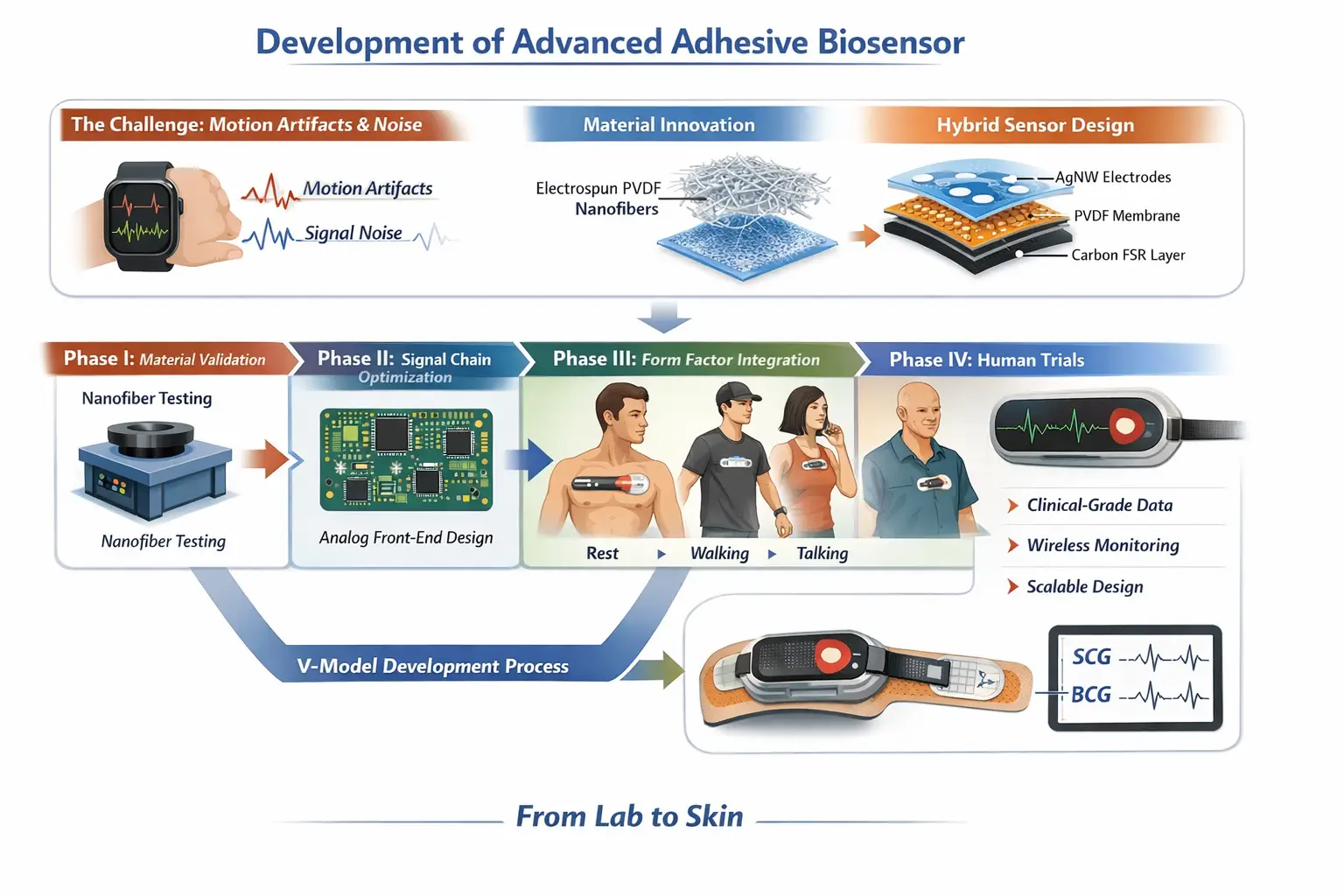
Wearable Adhesive Biosensor Utilizing Electrospun PVDF Nanofibers Using ESP32-S3
Our work on the ESP32-S3 Adhesive PVDF Biosensor Prototype is also relevant to low-power embedded product engineering.
That development combined sensitive analogue signal handling, ADC integration, BLE communication, firmware, and a reusable electronics architecture. Although the end use differs from a smart-home sensor, the engineering discipline around measurement quality, intermittent radio use, and compact battery-conscious hardware transfers directly.
Read Case Study
Wearable BLE Temperature Sensor Using nRF52840
The ThermaSense wearable project, involving Nordic nRF52840 hardware, MLX90632 temperature sensors, I2C multiplexing, timestamped firmware, and BLE connectivity, further demonstrates the practical challenges of multi-sensor acquisition and low-energy wireless design.
These experiences help our team consider sensor behaviour, not just MCU selection, when designing a long-life connected product.
Read Case StudyAmbiq Apollo4 Blue Smart Home Sensor Development Services
Product Discovery and Battery Life Assessment
The process of product discovery at Adequate Infosoft involves gathering requirement information, estimating battery life needed for the product, defining the installation environment and reporting frequency, assessing accuracy of measurement sensors.
The process of product discovery at Adequate Infosoft involves gathering requirement information, estimating battery life needed for the product, defining the installation environment and reporting frequency, assessing accuracy of measurement sensors, explaining connectivity method, determining mobile application features, and outlining target manufacturing costs.
Appropriate architecture, battery life models, components, risks, and production schedules are developed as a result of this stage.
This step allows clients to choose between Bluetooth, BLE gateway, Wi-Fi bridge, Matter bridge, or cloud-connected systems for the product.
Low-Power Hardware and PCB Development
Our engineers design custom electronics around the Apollo4 Blue platform, including schematic capture, component selection, battery and regulator design, sensor interfaces, antenna design, multilayer PCB layout, prototypes, BOM preparation, Gerber outputs, and manufacturing documentation.
Our engineers design custom electronics around the Apollo4 Blue platform, including schematic capture, component selection, battery and regulator design, sensor interfaces, antenna design, multilayer PCB layout, prototypes, BOM preparation, Gerber outputs, and manufacturing documentation.
We can integrate environmental sensors, contact switches, PIR sensors, accelerometers, light sensors, leak probes, buzzers, LEDs, buttons, displays, secure elements, and optional external connectivity modules. Every peripheral is reviewed for its effect on sleep current and active energy consumption.
Embedded Firmware and BLE Development
We develop low-power embedded firmware using event-driven scheduling, sleep-state control, sensor drivers, BLE services, secure provisioning, local data handling, fault recovery, diagnostic logging, and OTA-update support.
We develop low-power embedded firmware using event-driven scheduling, sleep-state control, sensor drivers, BLE services, secure provisioning, local data handling, fault recovery, diagnostic logging, and OTA-update support.
Our team can create custom BLE GATT profiles for mobile apps or gateways, support encrypted communication, and develop companion applications using Flutter, React Native, Android, iOS, or web dashboards according to the product requirement.
Management of Devices, Cloud and Mobile Application
Smart house sensor requires more than just the gadget - it should provide good user experience. Adequate Infosoft offers to create backend APIs, mobile application, notification service, tools for the installers, onboarding process for the devices, user roles, sensor history, rules for alerts, options for the subscriptions, and administrative portal.
Smart house sensor requires more than just the gadget - it should provide good user experience. Adequate Infosoft offers to create backend APIs, mobile application, notification service, tools for the installers, onboarding process for the devices, user roles, sensor history, rules for alerts, options for the subscriptions, and administrative portal.
In case of commercial deployment, we will assist with multitended device management, accounts for installers, accounts for customers, organization permissions, remote configurations, analytics, and help desk workflows.
Prototype Validation and Production Support
We help clients move from prototype to pilot and production through board bring-up, test firmware, power profiling, reliability testing, issue tracking, design revisions, factory-test planning, serial-number management, calibration processes, and engineering documentation.
We help clients move from prototype to pilot and production through board bring-up, test firmware, power profiling, reliability testing, issue tracking, design revisions, factory-test planning, serial-number management, calibration processes, and engineering documentation.
Why Work with Adequate Infosoft
When it comes to the implementation of a multi-year battery sensor, certain engineering decisions must be undertaken to ensure that the decisions made are measurable and verifiable into the future.
Adequate Infosoft offers a combination of advanced hardware, minimal energy firmware, BLE (Bluetooth Low Energy) capability, development on mobile platforms, back-end systems, and production support for various applications.
Their engineers closely follow realistic budget cycles, and create appropriate design parameters, stored validation parameters and sustainable product architecture.
Whether you are developing a smart-home sensor, connected access accessory, environmental monitor, or a complete IoT product line, we can help transform the concept into a practical Apollo4 Blue-based device ready for field validation and commercial scale.
Editorial Resources